













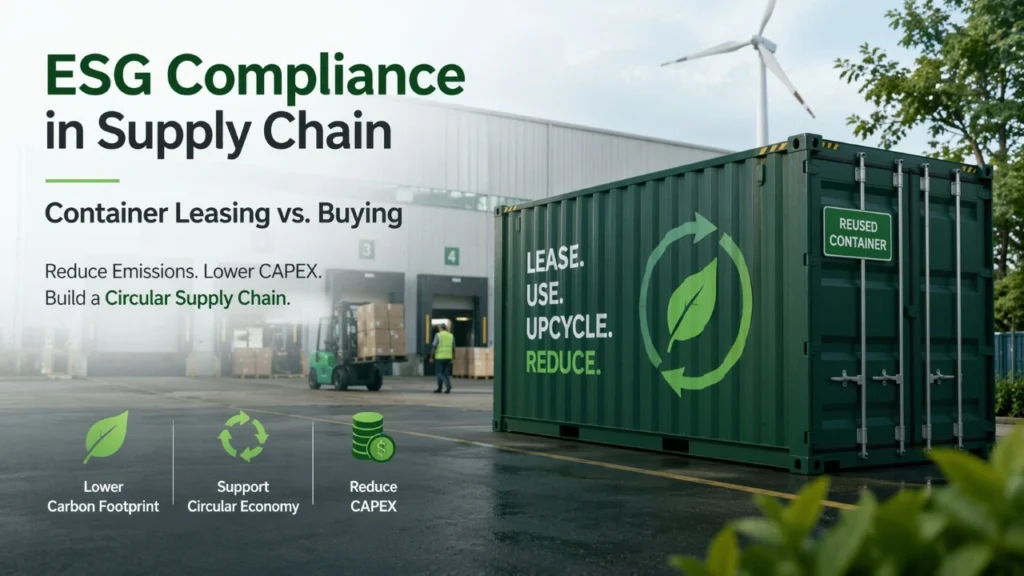
If you sit on the executive board of a major manufacturing, retail, or logistics enterprise, you already know that the corporate narrative has permanently shifted. Profitability and operational efficiency are no longer the only metrics that matter to your stakeholders. Today, investors, regulatory bodies, and consumers are demanding full transparency regarding your environmental impact, forcing executives to prioritize ESG (Environmental, Social, and Governance) compliance.
The inherent challenge for supply chain and operations directors is that logistics is traditionally a carbon-intensive industry. While companies often focus on transitioning to electric vehicle fleets or installing solar panels on corporate headquarters, they frequently overlook one of the most significant sources of emissions: infrastructure expansion.
When your company experiences a surge in inventory and requires additional storage space, the default reaction is often to build or acquire new warehouse facilities. However, the environmental cost of traditional construction is staggering.
As strategic logistics consultants, we are guiding forward-thinking corporations toward a more sustainable, financially sound alternative: the upcycling and leasing of shipping containers.
In this guide, we will break down how integrating leased containers into your supply chain strategy not only protects your capital but also provides hard, reportable data to drastically improve your ESG scores.
The ESG Mandate in Global Logistics
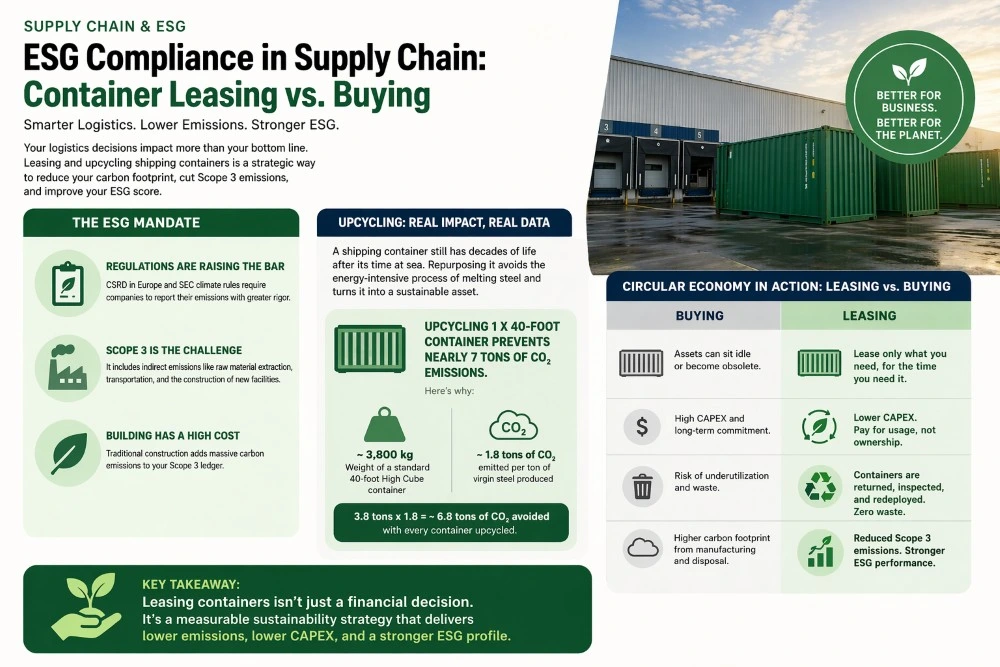
To understand the strategic value of container leasing, we must first examine the pressure facing modern supply chains. Regulatory frameworks, such as the Corporate Sustainability Reporting Directive (CSRD) in Europe and the SEC’s climate disclosure rules in the United States, are forcing large companies to audit their carbon footprint with unprecedented rigor.
These audits categorize emissions into three scopes. Scopes 1 and 2 cover direct emissions and purchased energy, which are relatively straightforward to measure and mitigate. The true logistical nightmare is Scope 3 emissions.
Scope 3 encompasses all indirect emissions that occur in a company’s value chain. This includes the extraction of raw materials, transportation, and the construction of new facilities required to support your operations.
If your company decides to pour concrete and erect a new steel-framed warehouse to handle seasonal overflow, the massive carbon footprint generated by manufacturing that cement and smelting that virgin steel is directly added to your Scope 3 ledger. To satisfy investors and meet strict emission reduction targets, executives must find ways to expand capacity without triggering these massive carbon penalties.
Upcycling: Giving Steel a Second Life
In the hierarchy of sustainability, recycling is good, but upcycling is vastly superior.
When a standard shipping container reaches the end of its maritime lifecycle (typically after 10 to 15 years of ocean transit), it remains an incredibly robust, weather-resistant structure made of high-grade Corten steel. If that container is sent to a recycling plant to be melted down and forged into new metal products, the smelting process requires extreme heat and consumes a massive amount of energy, generating significant emissions.
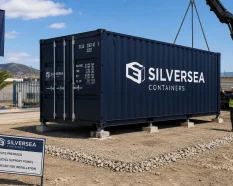
However, if we take that exact same container and repurpose it «as-is» for static ground storage, mobile offices, or temporary industrial facilities, we are engaging in pure upcycling. We are bypassing the energy-intensive recycling process entirely.
Let’s look at the raw data for your sustainability report: The metallurgical industry estimates that producing one ton of virgin steel generates approximately 1.8 tons of CO2 emissions. A standard 40-foot High Cube shipping container weighs roughly 3,800 kilograms (about 3.8 metric tons).
By choosing to upcycle a single 40-foot container instead of commissioning a new steel structure of equivalent size, your company effectively prevents the emission of nearly 7 tons of CO2. When you multiply that saving across a fleet of 20 or 50 containers used for a regional distribution hub, the positive impact on your annual environmental audit is undeniable. It provides your Chief Sustainability Officer (CSO) with concrete, quantifiable data to present to shareholders.

How Container Leasing Supports Circular Economy
While upcycling addresses the environmental aspect of ESG, the operational model you choose dictates your true commitment to sustainability. This is where the shift from purchasing to leasing becomes critical.
The traditional economic model is linear: take, make, use, and dispose. In the context of infrastructure, this means buying assets, using them until they are no longer needed, and then abandoning them or writing them off as a loss.
Leasing, on the other hand, is the cornerstone of the Circular Economy. When you sign a container leasing agreement, you are transitioning from asset ownership to «Space-as-a-Service.» Here is how leasing inherently drives sustainability:
- Maximized Asset Utilization: Your company leases the exact number of containers required for a specific timeframe—for instance, an 18-month contract to handle a retail peak season.
- Zero Waste Policy: Once your operational peak subsides and the contract ends, the containers do not sit empty and rusting in your yard. They are returned to our depot, fully inspected, maintained, and immediately redeployed to another client. The lifecycle of the steel box is extended to its absolute maximum potential, ensuring no resources are wasted.
- Reduced Footprint: Placing a shipping container on your property requires minimal ground preparation. Unlike building a permanent warehouse, you do not need to excavate the earth, disrupt local ecosystems, or pour permanent concrete foundations.
CAPEX vs OPEX in a Green Strategy
From the perspective of a Chief Financial Officer (CFO), sustainability initiatives are often viewed with skepticism due to their high upfront costs. However, container leasing perfectly aligns environmental compliance with financial efficiency.
Purchasing a fleet of shipping containers or funding a new warehouse construction requires a massive outlay of Capital Expenditure (CAPEX). It ties up the company’s liquidity in depreciating physical assets that may become obsolete if market demand shifts.
Conversely, leasing containers shifts the financial burden entirely to Operational Expenditure (OPEX).
- Financial Agility: Your business pays a predictable monthly rate, preserving cash flow for core business investments, R&D, or talent acquisition.
- Tax Efficiency: Lease payments are generally treated as fully deductible operational expenses, improving your short-term balance sheet.
- Risk Mitigation: You are not burdened with the long-term maintenance, depreciation, or eventual disposal of the asset.
By utilizing an OPEX model, your executive team can rapidly scale storage capacity up or down in response to market volatility, all while maintaining a pristine ESG profile.
Partner with Sustainable Vendors
Achieving true ESG compliance is not a solitary endeavor; it requires auditing the practices of your entire supply chain, including your equipment providers. To confidently report your sustainability metrics, you must partner with vendors who share your commitment to the circular economy.
At SILVERSEA Containers, we have spent over two decades facilitating sustainable logistics. Through our global network of over 200 logistics centers, we actively recover, inspect, and certify maritime containers, giving them a productive second life in the industrial sector.
We do not just supply steel boxes; we provide premium Cargo Worthy and One-Trip units that serve as the foundation for your green expansion strategy. Because our depots are strategically located worldwide, we drastically reduce the inland transportation miles required to deliver your containers, further minimizing your Scope 3 emissions.
Are you ready to align your operational growth with your corporate sustainability goals?
Contact our B2B enterprise team today. We will analyze your capacity needs and structure a customized leasing agreement that protects your capital and elevates your ESG reporting.