














Shipping industrial equipment—such as generators, pumps, compressors, construction machines, or manufacturing modules—can be a major logistical challenge. Many of these units are too tall, too bulky, or too complex to fit through the doors of a standard Dry van container. That’s where open topcontainers become invaluable.
Open tops are specifically designed for oversized, tall, or irregularly shaped cargo, allowing loading from above using cranes or forklifts. They are widely used in manufacturing, oil & gas, energy, construction, mining and large-scale industrial projects around the world.
This guide explores everything you need to know to ship industrial equipment using open top containers: dimensions, advantages, loading procedures, safety tips, documentation, and real-world examples.
What is an Open Top Container?
An open top container is a shipping container with the same base and structural strength as a Dry container, but without a fixed steel roof. Instead, it features:
- A removable tarpaulin (canvas or hard-top depending on the model)
- Steel support bows
- Full-width double doors
- Reinforced corner posts for oversized height
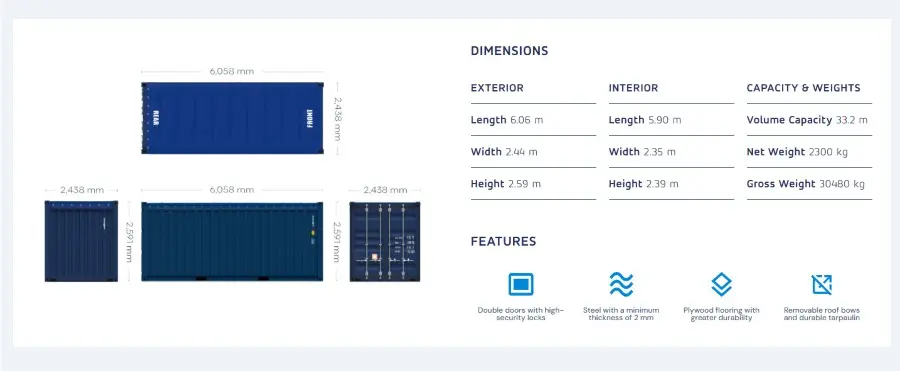
Standard specifications (ISO 668 – 2024)
20’ Open Top
- Internal length: ~5.89 m
- Internal width: ~2.35 m
- Internal height: ~2.35 m
- Payload: up to 28,000 kg
- Door height: ~2.28 m
40’ Open Top
- Internal length: ~12.03 m
- Internal width: ~2.35 m
- Internal height: ~2.35 m
- Payload: up to 30,000–32,000 kg
The key advantage is that equipment can be loaded from above, which is essential for tall or rigid items that cannot pass through the door opening.

Why use Open Top Containers for industrial equipment?
Industrial shippers prefer open top containers for several reasons:
1. Easy overhead loading
Unlike a Dry container, open tops allow cranes and overhead lifting systems to position heavy equipment safely inside.
Perfect for:
- Engines and turbines
- Compressors
- Generators
- Hydraulic units
- Construction machinery
- Modular equipment skids
2. Taller cargo accepted
Equipment that exceeds the door height of a standard container can still be loaded if it fits inside the internal height once placed.
Additionally, the tarpaulin roof can accommodate a slight height allowance if approved by the carrier.
3. Flexibility for irregular shapes
Industrial cargo is rarely a perfect rectangle. Open tops provide better maneuverability, allowing secure positioning even when dimensions are unconventional.
4. Heavy-duty structure
The floor is reinforced to support heavy loads and machinery with high point loads. Many open tops include:
- Thick marine-grade plywood floors
- Steel cross-members
- Built-in lashing rings rated up to 2,000 kg each
5. More accessible for maintenance operators
Workers can stand above the cargo to secure straps, chains, and protective padding, improving safety and efficiency during loading.
What types of equipment can be shipped?
Open top containers are ideal for:
- Construction machinery: small excavators, compact loaders, rollers
- Industrial generators
- Manufacturing modules
- Pumps and compressors
- HVAC units and cooling towers
- Electrical switchgear
- Oil & gas skids
- Mining machinery
- Large tanks or cylindrical components
They are also used for disassembled equipment shipped as multiple components.
How to load industrial equipment into an Open Top Container
Shipping equipment requires careful planning to prevent damage and ensure compliance with CTU Code 2024, ISO 3874, and carrier-specific safety rules.
Below is a technical step-by-step process:
1. Pre-inspection of the container
Before loading:
- Check structural integrity (no rust, cracks, or floor damage).
- Ensure lashing rings are intact and evenly distributed.
- Confirm payload capacity vs equipment weight.
- Verify the tarpaulin is in good condition with no tears.
2. Accurate measurement of the equipment
Essential measurements:
- Length, width, height
- Center of gravity
- Weight distribution
- Lifting points
These numbers must be provided to the carrier before booking.
3. Crane or forklift loading
Open tops are designed for overhead lifting.
Operators should:
- Use certified lifting points
- Avoid tilting during movement
- Position equipment slowly inside the container
- Ensure no contact with walls or corner posts
If equipment touches the container during loading, it might cause structural damage.
4. Securing and lashing (critical)
Industrial cargo must be secured to prevent shifting.
Best practices include:
- Heavy-duty chains or ratchet straps
- Wooden chocks or steel brackets
- Anti-slip mats under machinery
- Corner protectors
- Bolting machinery to wooden bases (if required)
Every lash point must be rated and tensioned properly.
5. Weight distribution
The weight should be centered:
- Along the longitudinal axis
- Avoiding heavy concentration on one side
- Maintaining stability during hoisting
Uneven loads are one of the leading causes of container damage.
6. Roof installation
Once the cargo is secured:
- Install steel bows
- Place the tarpaulin roof
- Seal the container according to carrier instructions
Some carriers require photos of the loading and sealing process for insurance.
Documentation Required
Industrial equipment shipping often requires additional documentation:
- Packing List
- Commercial Invoice
- Detailed Technical Sheet (dimensions, lifting points, CG position)
- Weight Certificate (VGM)
- Method Statement for loading (optional but recommended)
- Pictures of lashing and securing
Some equipment may also require:
- Hazardous equipment declarations
- Temporary export permits
- Manufacturer’s compliance certificates
Costs and factors to consider
1. Container rental rate
Typical open top rental:
- 20’ OT: €90–140 per week
- 40’ OT: €110–170 per week
2. Oversize surcharges
If the cargo height exceeds the container frame, carriers may apply OOG (Out of Gauge) fees, which can range from:
- €150 to €1,500+ depending on route and protrusion
3. Loading and lifting equipment
Cranes, forklifts, riggers and operators add to the total cost.
4. Insurance
Industrial equipment must be insured under an All Risks Marine Cargo policy.
Common mistakes to avoid
✔ Not providing exact dimensions → can result in denied loading.
✔ Inadequate lashing → leading cause of terminal rejections.
✔ Incorrect weight declaration (VGM) → port fines and delays.
✔ Not checking local regulations → some ports have stricter rules for oversized cargo.
✔ Underestimating loading time → cranes may be charged hourly.
Best practices for industrial shippers
- Always send a technical drawing to the carrier.
- Use riggers certified for heavy-lift operations.
- Request carrier approval before booking.
- Take photos of every step of the loading process.
- Use GPS trackers for high-value equipment.
- Perform post-shipment inspection on arrival.

Open top containers are an essential solution for industries moving tall, bulky, or heavy equipment that cannot be loaded through standard container doors. Their design allows secure overhead loading, flexible space for oversized cargo, and reinforced floors capable of carrying extremely heavy machinery.
By following proper loading procedures, securing methods and documentation requirements, companies can transport industrial equipment efficiently, safely, and in full compliance with global logistics standards.