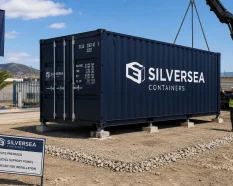















Shipping containers are increasingly used on private land for storage, workshops, modular buildings, agriculture, and even architectural projects. As their popularity grows, so does the question: Is it safe—and legal—to stack shipping containers on private property?
The short answer: yes, it can be safe, but only if you follow the correct engineering principles, load requirements, and local regulations. Unlike port or terminal environments—where containers are handled by certified equipment and engineers—private properties require additional precautions to avoid collapses, instability, water ingress, structural stress, or legal issues with local councils.
- In this guide, you’ll learn how to stack containers safely, what risks must be considered, which legal requirements may apply in the UK, US, EU and Australia, and when you must consult an engineer.
Is stacking containers allowed on private property?
In most countries, stacking containers is not prohibited by default, but what is regulated is:
- Structural safety
- Land use planning
- Aesthetic standards (in residential areas)
- Height limits
- Distance from boundaries
- Environmental or wind-load requirements
General rule: Stacking 2 or 3 containers is usually permitted if structurally safe and compliant with local planning laws.
When permits are commonly required
You may need planning permission when:
- Containers are stacked for more than 28–60 days (varies by country).
- Height exceeds 1 storey or 4.5–5 metres.
- Containers are used for habitation or converted buildings.
- They sit on land with zoning restrictions.
- The stack is visible from a public road or affects neighbours.
- The setup includes lighting, plumbing, or foundations.
Examples
- UK: Most councils require permission once containers become a “fixed structure”.
- US: Depends on zoning; many counties allow storage but regulate “structures over 12 ft high”.
- Spain/EU: Stacks may be considered “temporary industrial elements” unless used for housing.
- Australia: Councils commonly require engineering certification for stacked units.
Recommendation:
Always check local planning regulations and request clarification in writing.
Safety risks when stacking containers on private land
Stacking containers is safe only if the structure resists:
- Wind loads (the largest risk in open rural areas)
- Uneven or weak ground
- Incorrect load distribution
- Water accumulation or rusted roof panels
- Poor locking or lack of twistlocks
- Unsecured second-level containers
- Use of modified containers without reinforcements
Wind risk example
In coastal or open areas, wind gusts of 120–150 km/h can unbalance a poorly anchored stacked container—even if it seems heavy.
Structural failure example
If the bottom container is heavily corroded or modified (windows, panels removed), the stack may collapse under vertical load.
Engineering rules for safe stacking
Stacking containers is not as simple as placing one on top of another. The following principles are essential.
A) Load must be supported by corner posts only
ISO containers are engineered so that 100% of vertical load is carried by the four corner posts—NOT the roof panel or side walls.
Never stack if:
- The upper container rests on roof panels
- Side walls are carrying load
- The bottom unit’s corner posts are damaged or cut
B) Use twistlocks or interlocking devices
For safe stacking, always use:
- Manual twistlocks
- Semi-automatic twistlocks (SATLs)
- Bridge clamps
These prevent lateral movement during wind or seismic activity.
C) Ensure the bottom container is in excellent structural condition
Inspect:
- Corner posts
- Sills
- Crossmembers
- Rust levels
- Any modifications
Weak structural elements reduce stacking capacity drastically.
D) Foundation must be flat, level, and load-bearing
Containers should sit on:
- Reinforced concrete pads
- Rail sleepers
- Concrete blocks
- Steel beams
- Gravel compacted to 95–98% Proctor
Avoid stacking on:
- Soft soil
- Mud
- Sloping terrain
- Uncompacted ground
E) Consider total vertical load
A typical 40 ft container can support:
- Up to 192,000 kg when stacked (ISO-tested for vertical load)
- But only if in excellent structural condition
Used containers with corrosion may handle significantly less.
F) Avoid stacking modified containers unless reinforced
Containers with:
- Large window cut-outs
- Doors
- Removed panels
- Open side modifications
cannot be safely stacked unless reinforced with a structural frame.
Recommended stacking configurations
1. Standard 2-tier stack
Most common, safe if:
- Both containers are ISO-certified
- Twistlocks are used
- Foundations are level
2. Three-high stacks
Possible but only if:
- Engineering certification is obtained
- Wind loading is analyzed
- Foundations are reinforced
3. L-shaped or perpendicular stacks
Used in architectural projects.
Must be engineered due to uneven load distribution.
Legal considerations
Although regulations vary, these elements are common worldwide.
A) Zoning and land-use rules
Check land classification:
- Residential
- Rural/agricultural
- Industrial
- Commercial
Residential zones often have height, noise, and aesthetic restrictions.
B) Building permits
You may need a permit if:
- Containers remain longer than temporary use
- Height exceeds local limits
- Containers are used as a building or workspace
C) Fire safety compliance
For stacks near buildings or property boundaries, consider:
- Distance requirements
- Fire separation
- Escape routes for inhabited containers
D) Environmental compliance
Drainage and water runoff may be regulated.
E) Insurance requirements
Some insurers refuse coverage if stacks are not:
- Anchored
- Engineered
- Documented

Practical safety checklist
Before stacking, inspect:
✔ Ground level and resistance. Use a laser level or professional survey.
✔ Condition of corner posts. Rust can reduce load capacity by 40–60%.
✔ Twistlocks installed. Absolutely mandatory.
✔ Corrosion on top rails. Weak top rails may deform under load.
✔ Wind exposure. Rural or coastal land requires anchoring.
✔ Modifications or cut-outs. Do not stack modified units without reinforcement.
✔ Weight distribution. Heavier container should go on the bottom.
✔ Drainage. Avoid water pooling around foundations.
When to hire a structural engineer
Consult a certified engineer when:
- Stacking 3 or more containers
- Containers have structural modifications
- The land has uneven terrain
- You plan to use the stack as a building
- Local planning requires certification
- The area is exposed to strong wind
This is common in UK, Australia, EU coastal regions and North American rural areas
Frequently asked questions
Yes, if proper foundations and twistlocks are used.
Often no—unless they stay long-term or exceed height limits.
Yes, but building regulations apply, including insulation, fire safety, and engineering certification.
Not without reinforcement.
2 is common; 3 requires engineering; more than 3 is rarely allowed outside ports.
No. CSC is for international transport only.
Stacking containers on private property is safe when done with proper engineering, structural checks, and the right anchoring systems. Although most countries do not explicitly ban stacking, regulations on height, land use, and permanence can apply.
By assessing ground stability, using twistlocks, reinforcing modified units, and consulting an engineer when necessary, you can build stable and durable container structures that meet both safety and legal standards.
Ready to secure your project?
You now know the keys to safety and the necessary regulations. The next step is to acquire the ideal shipping containers for your project. Request your quote today.
We can help you find the storage or construction solution you need.
- Sale and Rental: We offer options for purchase or flexible leasing.
- New and Used Containers: Choose the option that best fits your budget and condition requirements.
[Click here to get a quote for your new or used containers, for sale or rent.]