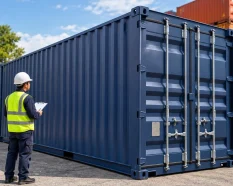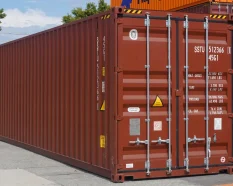














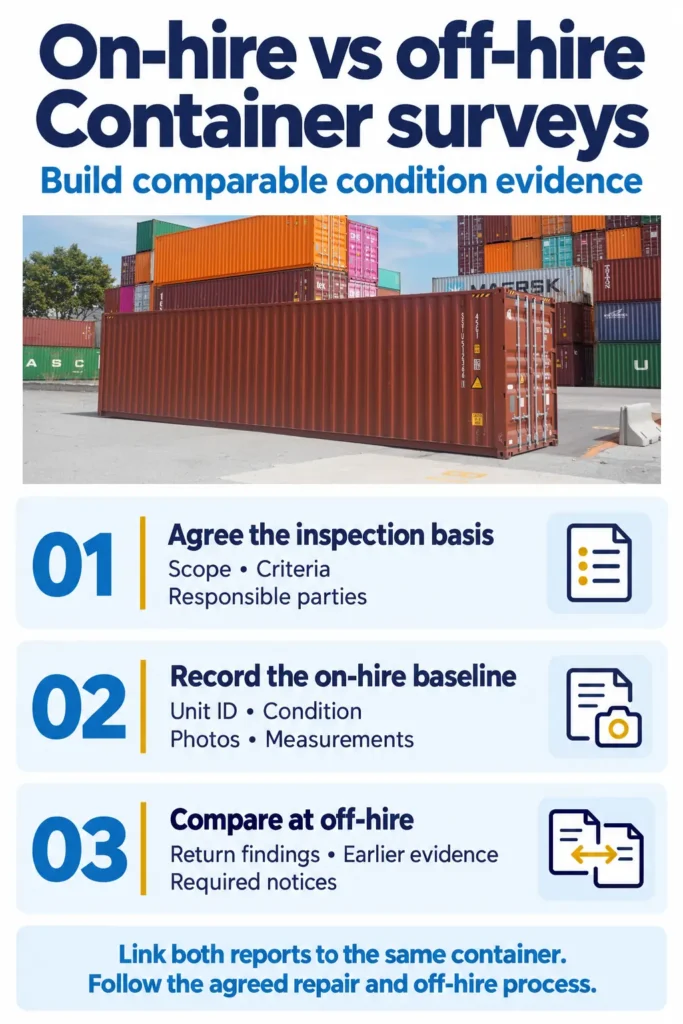
An on-hire container survey records condition at the agreed start-of-hire handover. An off-hire survey records condition at redelivery and supports comparison with that baseline. The useful question is what changed, measured against which criteria, and with what supporting evidence.
For UK and European businesses, the inspection scope, responsible parties and acceptance process should be agreed before collection or return. A survey records findings; the applicable agreement and process govern repair decisions, costs and the completion of off-hire.
On-hire vs off-hire surveys at a glance
Both assessments need an identified unit, an agreed inspection basis and traceable records. Their roles differ:
| Aspect | On-hire survey | Off-hire survey |
|---|---|---|
| Timing | At the agreed release or start-of-hire point. | At the agreed redelivery point. |
| Purpose | Establish the condition baseline for the identified unit. | Record return condition and compare it with the baseline. |
| Inspection basis | Agreed equipment-specific scope and criteria. | The return criteria and scope specified for the equipment. |
| Next steps | Record exceptions and obtain authorised instructions. | Review findings, required notices and any repair or off-hire decision. |

Share the packed dimensions, weight, handling method and location with SILVERSEA Containers.
What an on-hire container survey establishes?
The on-hire assessment provides a condition baseline for the unit being released. Confirm who performs it, which report is required and how the receiving party can review or challenge recorded findings.
The baseline should identify existing damage, repairs, corrosion, cleanliness issues and any limitations of the inspection. Keep photographs and measurements linked to the relevant findings rather than as an unidentified image folder.
Before operational use, follow the agreed process for reporting a mismatch or subsequently discovered condition. Check the notice route and any deadlines instead of assuming that a verbal comment at the gate changes the record.
What an off-hire container survey establishes?
The off-hire assessment records condition at the agreed redelivery point. Compare its findings with the on-hire baseline and the return criteria specified for the equipment.
The comparison may raise questions about existing damage, a new observation, wear, cleaning or an earlier repair. It does not automatically establish when an issue arose or who must pay. Separate the inspection finding, any proposed work and the contractual decision.
Confirm inspection scope before either handover
Agree which areas are covered, what access is available and who is competent to inspect the particular equipment. The scope may include:
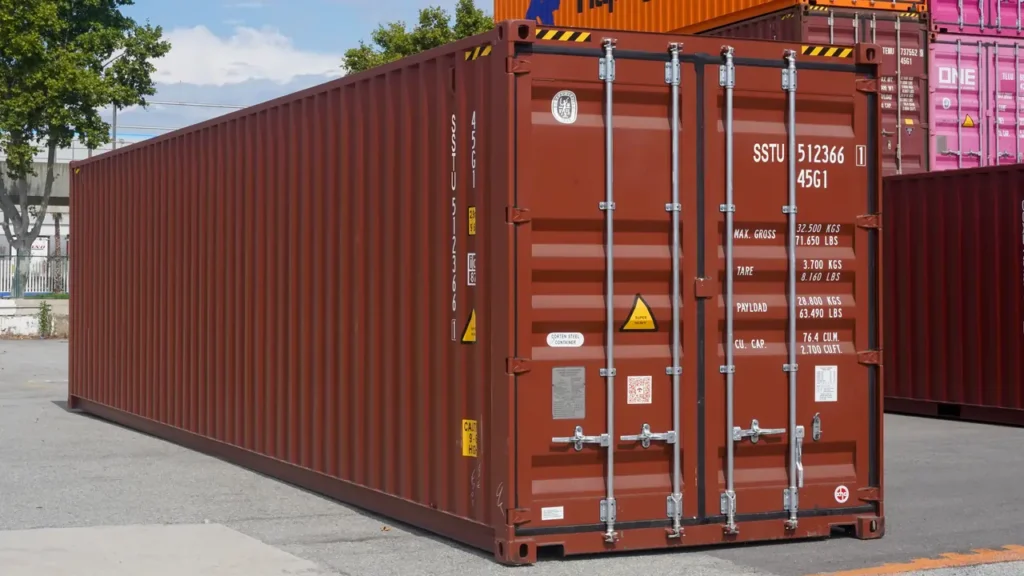
- Identity, equipment type, markings and relevant data plates.
- Corner posts, rails, side panels, cross-members and other structural components.
- Doors, locking gear, hinges, handles, gaskets and seals.
- Roof, floor and accessible understructure, including visible damage or previous repairs.
- Cleanliness, residue, odour and water-ingress indicators where relevant.
- Equipment-specific systems, tests or records included in the agreed scope.
Use authorised, safe access arrangements. Record any inaccessible areas or checks not performed; do not treat an uninspected area as confirmed satisfactory.
Dry containers, reefers, tanks, open tops, flat racks and modified units need appropriate scopes. For example, reefer machinery checks require their own agreed procedures and records; a dry-container visual checklist does not cover them.
Name the inspection criteria and edition
The agreement may refer to a lessor’s condition schedule, an owner’s repair guide or industry guidance. IICL inspection and repair publications provide reference criteria and procedures; confirm the publication, edition, equipment type and contractual basis being used.
Do not turn an industry guide into a universal damage threshold. Ask how wear, corrosion, contamination and non-conforming repairs are classified under the applicable criteria, and which measurements are required to support a finding.
Evidence to retain for each container survey
The record should let another person connect the findings with the correct unit, event and inspection basis. Retain the following information:
| Evidence item | Why keep it | What to verify |
|---|---|---|
| Unit identification | Links findings to the correct container. | Consistent container number, equipment type and asset reference. |
| Survey and gate records | Distinguishes inspection findings from the interchange event. | Required report, EIR or electronic record and the agreed format. |
| Date and location | Places findings in the handover context. | Actual inspection date, time and facility. |
| Condition details | Identifies the nature and location of a finding. | Specific description or code, applicable criteria and comparison with prior condition. |
| Photographs | Shows context and details where permitted. | Identifiable overview and useful close-ups linked to the report. |
| Measurements | Supports findings where the criteria require them. | Method, units, location and recorded results. |
| Inspector or depot | Makes the author and role traceable. | Responsible person or organisation and their inspection role. |
| Submission and retention | Keeps notices and records retrievable. | Submission route, required acknowledgements, retained copies and applicable deadlines. |
A useful photo set combines identifiable wider views with close-ups of a specific finding. Include scale or measurements where the agreed criteria require them. Where photography is restricted, confirm the facility’s alternative recording and retrieval process.
EIR, survey report and CSC examination: Different functions
An Equipment Interchange Receipt (EIR) records a handover or gate event and may contain condition information. A survey report sets out inspection findings against an agreed scope. Confirm which documents your operation requires and whether the EIR is part of the condition evidence or a separate interchange record.
CSC safety approval and examination address a separate compliance question. The IMO’s CSC overview explains the framework for safe containers and approved examination arrangements. A commercial survey or a plate marking alone should not be treated as proof that every requirement for the intended movement has been met.
The CSC definition of ‘owner’ can include a lessee or bailee when an agreement provides for their exercise of maintenance and examination responsibilities. Identify the applicable arrangements and national implementation for the unit; keep these duties separate from the allocation of survey, cleaning and repair charges.
If an examination under an approved continuous examination programme (ACEP) is intended, confirm the applicable programme and required examination scope. Do not assume that every commercial on-hire or off-hire survey fulfils that role.
Responsibility: Review the evidence before deciding on work or costs
When a finding is raised at return, work through the evidence and agreed process in order:
- Verify identity and context. Check the container number, date, location and precise area concerned.
- Compare with on-hire evidence. Review earlier remarks, photographs, repairs and inspection limitations.
- Apply the agreed criteria. Obtain the description, codes and measurements supporting the classification.
- Check the approval and notice process. Identify who may authorise work, who must be notified and the applicable response requirements.
- Retain the decision and supporting records. Keep any report correction, repair estimate, authorisation or challenge linked to the original finding.
For example, an off-hire report may record corrosion on a door component. Compare that location with the on-hire images and the agreed wear criteria before deciding what the observation means. A later photograph alone does not establish when the condition developed or settle responsibility.
If a finding affects safety or intended use, refer it to the responsible competent person before further use. A disagreement over commercial costs should not delay the required safety assessment.
Practical checks before pickup and redelivery
Before on-hire or collection
- Confirm the lease terms, inspection scope, criteria and authorised inspector or depot.
- Agree the report, EIR, photographs and equipment-specific records required.
- Check how to report existing defects, record limitations and raise subsequently discovered issues.
- Nominate the contact who can resolve discrepancies and retain the accepted record.
Before off-hire or redelivery
- Confirm the current return depot, reference, appointment and redelivery instructions.
- Check cleaning and preparation requirements; follow the agreed repair-authorisation process.
- Agree how inspection findings and supporting evidence are submitted and challenged.
- Confirm what completes redelivery or off-hire, who receives notice and when charges cease under the agreement.
The guide to choosing a container depot in Europe covers facility and gate requirements. For one-way container rental, confirm the agreed return point and the evidence needed for that route before dispatch.
Plan your leasing and handover requirements
When considering maritime container leasing, share the equipment type, quantity, intended use, origin, destination, dates and redelivery plan with SILVERSEA Containers. Explain the inspection and evidence requirements relevant to your operation.
Request a container leasing quote and ask the team to confirm the available commercial options and proposed scope for your location. Agree survey appointments and record acceptance with the responsible provider or inspector before the handover.
Frequently asked questions
On-hire records the baseline condition at the agreed release or start-of-hire point. Off-hire records return condition and supports comparison with that baseline and the agreed return criteria.
It depends on the required scope and process. An EIR may include condition information, but a detailed survey may need findings, criteria, measurements and photographs that the gate record does not contain. Confirm the required documents before handover.
Do not assume so. Check the inspection criteria incorporated into the agreement, including publication, edition and equipment type. Other owner or lessor requirements may apply. An industry reference is not a universal contractual standard.
Review the agreement, applicable criteria, on-hire evidence and return findings. The report records an observation; it does not by itself assign every repair or cleaning cost. Follow the agreed notice, approval and dispute process.
Do not assume that the inspection date alone completes off-hire. Confirm the authorised return location, receipt or acceptance requirements, required notices and the event that ends charging under the agreement.
A commercial condition assessment does not automatically fulfil a required safety examination. If the operation also requires a CSC examination, confirm the applicable scheme, responsible parties and examination records separately.