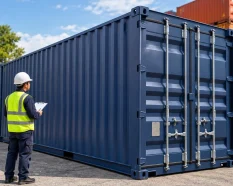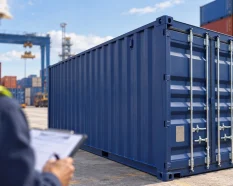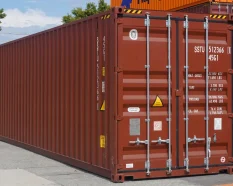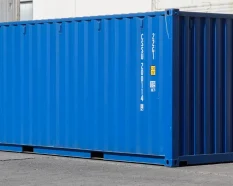















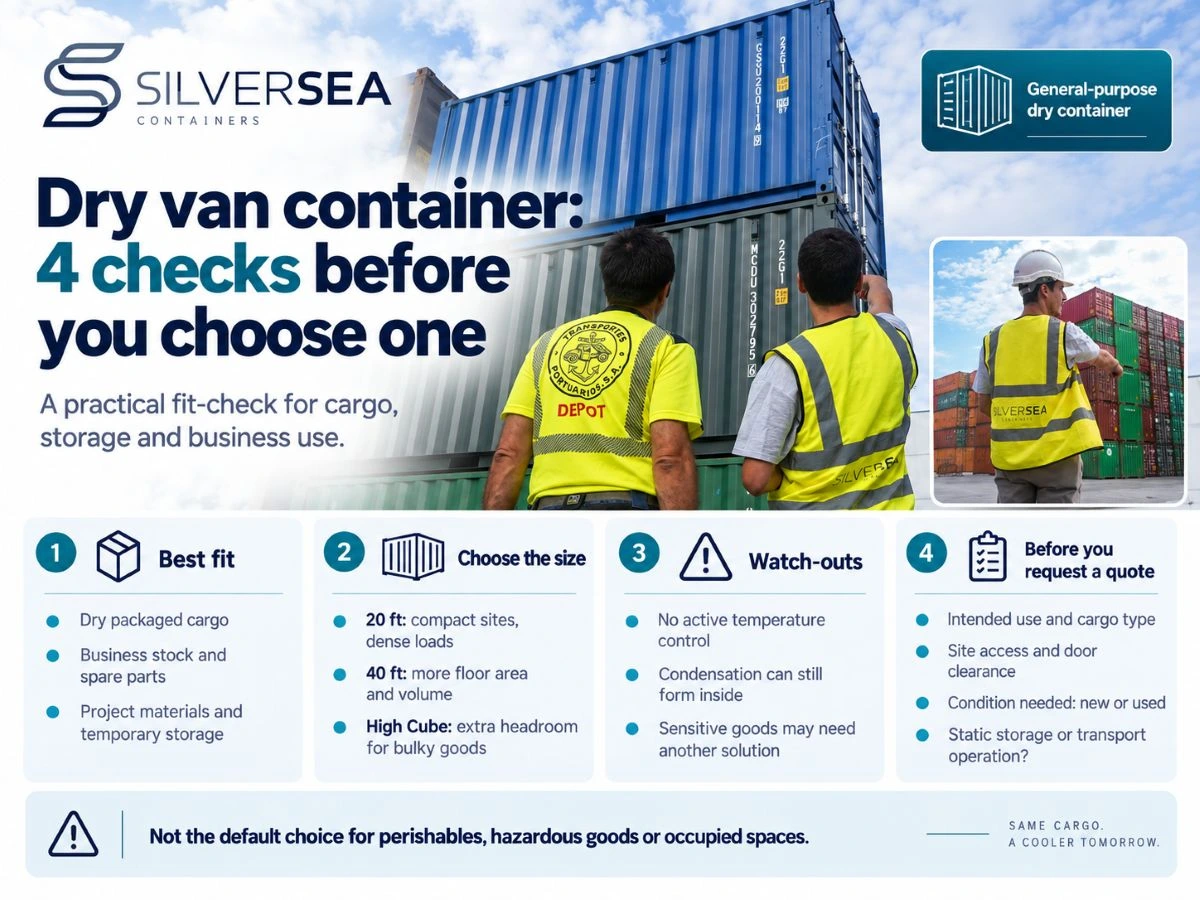
A dry van container works well when the goods are dry, properly packed, within the unit’s dimensional and weight limits, and do not require active temperature or humidity control.
It is widely used for general cargo, business stock and temporary storage, but that does not mean every dry-looking product is automatically suitable for a standard container. Perishables, pharmaceuticals, highly moisture-sensitive goods, hazardous materials and occupied spaces may require another type of equipment, additional controls or a purpose-specific technical assessment.
The dry van is the standard enclosed container used across intermodal transport and many static storage projects. Its main advantages are straightforward: a rigid steel structure, standardised handling points, lockable cargo doors and a large enclosed space that can be moved, delivered or positioned according to the operation.
Its limitations are just as important. A dry van does not actively control temperature or humidity, and suitability depends on the cargo, storage duration, climate, site, condition of the unit and whether it will remain static or enter a transport chain.
What is a dry van container?
A dry van container — also called a dry container or general-purpose container — is an enclosed freight container with a rigid roof, walls, floor and cargo doors. It is designed primarily for general cargo that does not require active refrigeration or another controlled-temperature system.
Under ISO 6346, general-purpose containers belong to the G type family within the ISO size and type coding system. The exact code depends on the dimensions and characteristics of the individual unit, so the container’s markings, data plate and specification should always be checked rather than assuming that every dry van has identical characteristics.
The most common formats are 20 ft standard, 40 ft standard and 40 ft High Cube. A High Cube dry container is still part of the dry/general-purpose container family; its main difference is the additional external and internal height.
If you want to compare this equipment with other configurations, see the SILVERSEA Containers maritime container range.
Exact internal dimensions, door openings, tare, payload and maximum ratings vary by design and manufacturer. Generic size charts are useful for planning, but they should not replace the specification of the unit actually being supplied.
A dry van in suitable condition is designed to protect cargo from direct exposure to rain, snow, dust and sunlight. It does not maintain a fixed temperature, remove moisture from the air or eliminate the risk of condensation.
When does a dry van container work well?
The strongest use cases share the same basic conditions: the goods are dry, they can tolerate the expected temperature range, their packaging is appropriate for the storage or transport environment, and the container itself can be kept clean, structurally sound and secure.
| Use case | When a dry van can work | What to confirm |
|---|---|---|
| Packaged dry cargo | Cartons, bagged goods, furniture, components or palletised products that are not temperature-sensitive | Packaging, weight, dimensions, load distribution, securing and route acceptance |
| Business stock | Tools, spare parts, retail inventory and equipment stored at a business site | Duration, access frequency, security, moisture sensitivity and insurance |
| Project storage | Temporary materials or equipment for construction, maintenance or industrial work | Delivery access, support points, drainage, door clearance and retrieval plan |
| Paper, textiles or electronics | Only when the goods, packaging and storage period can tolerate the expected environment | Humidity strategy, monitoring, insulation or a different solution |
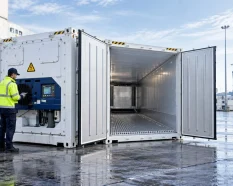
| Chilled, frozen or heat-sensitive goods | Generally unsuitable without a validated specialist solution | Required temperature range, monitoring and whether reefer equipment is necessary |
| Hazardous goods or batteries | Never by default simply because the unit is enclosed and lockable | Classification, packaging, segregation, ventilation, fire risk and applicable requirements |
| Office or workshop | Only after purpose-specific conversion and site assessment | Ventilation, insulation, electrics, fire safety, structural alterations and local requirements |
The decision principle is therefore not simply to choose an enclosed container because the goods appear dry. Choose the environmental performance and physical condition required by the goods, rather than merely the cheapest available container.
Dry van containers for cargo
For transport, a dry van is the starting point for a wide range of general cargo. Boxed manufactured goods, furniture, machinery parts, packaged retail products, building materials, palletised stock and many other non-perishable loads can all be suitable, provided that their individual requirements match the equipment.
Suitability is always load-specific. Before packing, the container should be checked for cleanliness, dryness, visible damage or contamination, while the cargo itself must be capable of being distributed and secured appropriately for the planned journey.
If the unit will enter international transport, the individual container’s CSC status, examination status where applicable, ratings and structural condition should also be verified, together with any carrier, terminal or route-specific requirements.
A commercial resale description such as Cargo Worthy, Wind and Watertight or As-Is should not be treated as a substitute for the approvals and operational checks required for maritime transport. The original article correctly separates commercial condition labels from CSC and transport suitability.
If you are comparing used equipment, our guide to used shipping container grades in Europe explains the practical differences between common commercial condition categories.
Dry van containers for business storage
Dry containers can also provide temporary or additional storage capacity close to the point of use. Businesses may use them for overflow inventory, spare parts, tools, seasonal stock, maintenance equipment or materials associated with a temporary project.
The container itself, however, is only one part of the solution. The site needs enough space for safe delivery and unloading, stable and level support beneath the unit, adequate drainage and sufficient clearance to open and use the doors. Access frequency, lighting, security, fire risk, insurance and the eventual removal or relocation of the unit also form part of the planning process.
Planning, building-control and site requirements vary by country and local authority across the UK and Europe. Whether permission or another approval is required can depend on the location, duration, use, modifications and characteristics of the installation.
Do not assume that describing a container as temporary or movable automatically removes local planning or site requirements. Check the position with the relevant authority where necessary before installation.
Which dry van size should you choose?
Choosing between a 20 ft, 40 ft and High Cube dry container is not simply a decision between more or less space. Cargo volume and density matter, but so do delivery access, manoeuvring room, door clearance and how frequently the contents will be accessed.
Common dry container formats
| Format | External dimensions | Approx. internal space | Typical decision logic |
|---|---|---|---|
| 20 ft standard | 6.058 × 2.438 × 2.591 m | Approx. 5.90 × 2.35 × 2.39 m; around 33 m³ | Compact sites, smaller batches and relatively dense cargo, subject to unit payload |
| 40 ft standard | 12.192 × 2.438 × 2.591 m | Approx. 12.03 × 2.35 × 2.39 m; around 67 m³ | Higher-volume loads when the site and transport plan can accommodate the length |
| 40 ft High Cube | 12.192 × 2.438 × 2.896 m | Approx. 12.03 × 2.35 × 2.69 m; around 76 m³ | Bulky or taller loads that benefit from extra headroom |
These are common industry approximations rather than specifications for every individual container. Internal dimensions, door openings, tare, payload and maximum ratings may vary, so the data for the selected unit should always be checked before finalising cargo or site plans.
A 20 ft dry container can be particularly practical when site space is restricted, quantities are smaller or the cargo is relatively dense. It also requires less physical space than a 40 ft unit for positioning and routine access.
A 40 ft dry container provides considerably more floor area and internal volume, making it more suitable for bulky stock, larger batches, furniture, palletised goods and higher-volume storage. The trade-off is the additional delivery, turning and operating space it requires.
A 40 ft High Cube adds headroom rather than automatically adding payload. It is particularly useful when cargo is bulky, taller or relatively light and vertical space is more important than additional weight capacity.
For a broader comparison, review the maritime container types and common sizes available from SILVERSEA Containers.
Share the packed dimensions, weight, handling method and location with SILVERSEA Containers.
New or used dry van: condition changes the decision
A newer or One Trip dry van can be useful when appearance, cleanliness or reduced wear are important. This may apply to customer-facing locations, planned conversion projects or goods for which previous cargo history, staining or odours are relevant.
A newer unit does not, however, create temperature or humidity control. It remains a dry container with the same fundamental environmental limitations.
A used container may be commercially appropriate for both cargo and business storage when its condition matches the intended use. Cosmetic dents, paint wear or superficial corrosion do not necessarily make a container unsuitable. Damage affecting doors, seals, roof, floor, corner posts, rails, corner castings or the underframe is more significant because it can affect handling, security, weather protection or structural performance.
Commercial terms such as Cargo Worthy, Wind and Watertight and As-Is describe different expectations, but their exact inspection scope can vary between suppliers and markets. Our guide to used shipping container condition grades explains these classifications in more detail.
For static storage, the useful question is not simply whether the container is “used”, but whether it provides the level of structural integrity, dryness, door operation, sealing, floor condition and cleanliness required for the project.
For maritime use, the CSC information and examination status of the individual unit should also be checked.
If ownership rather than temporary use fits your requirement, you can review container purchase options from SILVERSEA Containers.
Moisture and condensation: the main dry van limitation
A dry van can keep direct rainfall away from the cargo and still develop moisture inside. This distinction is particularly important for business storage because an enclosed steel box is not the same as a climate-controlled environment.
Condensation can occur when humid air, damp cargo, packaging or timber introduces moisture into the container and changing temperatures cause that moisture to reach the dew point on colder surfaces.
Risk can increase with wet pallets, damp cargo, goods that release moisture, long storage periods, large differences between day and night temperatures, unsuitable packaging and poor airflow. Paper, textiles, timber products, metal components, electronics and boxed stock may therefore require additional planning even though they would ordinarily be described as dry goods.
A practical moisture strategy starts by loading dry cargo, packaging and dunnage into a clean and dry container. Roof condition, floor, vents and door seals should be checked before use, and moisture-sensitive products may need to be kept away from walls or flooring where appropriate.
Depending on the actual risk, desiccants, monitoring, insulation or controlled ventilation may form part of the solution. Long-term storage should also include periodic checks rather than assuming that a locked container requires no further attention.
Moisture absorbers do not turn a dry van into a climate-controlled room, and ventilation is not automatically beneficial. In a humid external environment, additional ventilation may introduce more moisture rather than remove it.
The correct approach depends on the combination of cargo, climate, duration, packaging and temperature cycle. The source draft already makes this distinction explicitly and it is worth preserving because it is one of the article’s most useful technical sections.
When should you choose another container or solution?
A dry van should not be the default when the key operating requirement is temperature control, specialist ventilation, oversized loading, liquid containment, dangerous-goods controls or human occupancy.
| Requirement | Option to assess |
|---|---|
| Defined temperature range | Reefer container or another validated temperature-controlled system |
| Reduced temperature fluctuation without active refrigeration | Insulated equipment |
| Cargo that cannot be loaded safely through standard end doors | Open Top, Flat Rack or Open Side configuration |
| Liquids or bulk products | Purpose-designed tanks, packaging or containment systems |
| Batteries, chemicals, fuels or other hazardous goods | Specialist solution based on classification and applicable requirements |
| Office, workshop or another occupied use | Professionally designed conversion and site assessment |
You can compare these alternatives in the SILVERSEA Containers maritime container catalogue. An unmodified dry van should not be assumed to be an automatically compliant workplace.
What should you inspect before accepting a dry van?
Here a numbered checklist does add value, because the reader is expected to perform a sequence of checks rather than simply absorb descriptive information.
1. Confirm identity and specification
Check the container number, ISO size/type code, external and internal dimensions, door opening, tare, maximum gross rating and any restrictions specific to the unit.
2. Inspect the structure
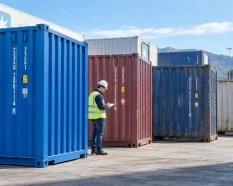
Review the corner posts, corner castings, rails, roof, walls and underframe for damage that could affect handling, transport or storage.
3. Check doors and seals
Open and close both doors and inspect the locking bars, hinges, handles, gaskets and threshold. The agreed level of weather protection should be appropriate for the intended use.
4. Review the interior
Look for holes or visible daylight through damage, water marks, floor deterioration, contamination, strong odours, residues or evidence of pests.
5. Match approval to use
For international transport, verify the CSC plate and examination status. For static storage, review the relevant planning, site, fire and insurance considerations.
6. Record the handover
Keep dated photographs, container identification, the agreed condition description and any available delivery or inspection record.
If the unit will be collected or inspected at a depot, our guide on how to choose a container depot in Europe explains the location, access and operational factors worth checking.
How to request the right dry van quotation
A useful quotation starts with the operating requirement rather than simply with “20 ft container” or “40 ft container”.
The supplier needs to understand four main areas.
- Location and delivery: country, city, postcode, preferred delivery or collection point, access conditions, unloading method and available manoeuvring space.
- Equipment: quantity, preferred size, standard or High Cube format, condition and whether the project involves purchase, lease or another available arrangement.
- Cargo and use: intended purpose, cargo type, packaging, moisture or temperature sensitivity and whether the unit will remain in static storage or enter maritime transport.
- Timing and additional requirements: target dates and any security, ventilation, insulation, monitoring or modification needs.
This provides enough information to assess the likely equipment and delivery scope without forcing the reader through another long checklist. The source draft identifies the same core information in its quotation section.
If the project involves purchasing the unit, review our maritime container purchase options before preparing the request.
Request a dry van container quote
Tell SILVERSEA Containers where the container is needed, the quantity, intended use, preferred size and condition, and whether the unit will remain in static storage or enter a transport operation.
With that information, our team can assess suitable dry container options and prepare a quotation subject to equipment availability, depot, delivery requirements and technical confirmation.
Request a tailored container quote
Share the packed dimensions, weight, handling method and location with SILVERSEA Containers.
Frequently asked questions about dry van containers
Usually, yes. Dry van, dry container and general-purpose container generally refer to the same enclosed, non-refrigerated container family.
The names alone, however, do not define every technical characteristic of an individual unit. The ISO size/type code and specification should still be checked.
It is better not to describe a dry van simply as “waterproof”.
A suitable unit in appropriate condition is designed to protect cargo from direct weather exposure, but that does not mean its interior will always remain free from moisture. Roof condition, door seals, vents, packaging, cargo moisture and temperature changes can all influence the internal environment. A dry van is not humidity-controlled.
Yes, provided that both the goods and the site are suitable.
Long-term storage should account for support and drainage, security, access, moisture management and periodic inspection. Goods that are sensitive to changes in humidity or temperature may need monitoring, insulation or another type of container.
The decision should reflect both the cargo and the site.
A 20 ft container is more compact and can work well for smaller batches, relatively dense cargo and sites where positioning space is limited. A 40 ft container offers considerably more floor area and volume but also needs more space for delivery and routine operation.
A 40 ft High Cube provides extra height, which can benefit bulky cargo, but does not automatically provide a higher payload.
Yes, when it is a general-purpose dry High Cube. The principal difference is additional height.
The exact ISO size/type code and unit specification should nevertheless be checked because “High Cube” describes dimensions rather than every technical characteristic of the container.
Potentially, but a commercial description such as Cargo Worthy does not by itself confirm maritime eligibility.
The exact unit must be suitable and accepted for the movement, taking into account its CSC plate, examination status, structural condition, ratings and applicable carrier and terminal requirements.
It should not be treated as an automatically compliant occupied space.
Ventilation, insulation, safe access, electrical systems, fire precautions, structural alterations and local planning or building requirements may all need purpose-specific assessment. A professionally designed conversion is the appropriate starting point for occupied uses.