













A container lease quote is more than a daily rental price. It defines the equipment being offered, the conditions under which it can be used and returned, and the responsibilities that may affect the final cost of the agreement.
For procurement teams, freight forwarders and logistics managers, comparing container lease quotes requires looking beyond the headline per diem. Two offers with similar daily rates may involve different collection locations, redelivery conditions, handling costs, inspection requirements or damage liabilities.
The key is to compare the full commercial scope, not just the rental rate. Before accepting a proposal, confirm when rental charges begin and end, which services are included, where the container can be returned and what happens if the equipment is damaged or the agreed lease period changes.
This guide explains the main terms found in container leasing quotations, the questions worth asking before signing and a practical method for comparing offers on a consistent basis.
Important: Container leasing conditions vary by supplier, equipment type, location and transaction. The explanations below are intended to help interpret a quotation, not to establish universal contractual, legal, tax or insurance requirements.
Understand the Quote Structure: Lease Schedule vs Master Agreement
The document labelled «quotation» may not contain every obligation governing a container lease.
Depending on the supplier and transaction, the commercial documentation may include:
- Quotation: The proposed equipment, rental rate, locations, dates and commercial conditions.
- Lease schedule: Transaction-specific terms that may identify the containers, pricing, duration and return arrangements.
- Master agreement: A wider contractual framework governing responsibilities, payments, permitted use, damage, insurance and other obligations.
- Depot instructions: Operational procedures for collection, inspection, handling and redelivery.
- Additional terms or incorporated standards: Documents referenced by the agreement that may establish further requirements.
Not every supplier uses this structure. Some agreements consolidate the relevant terms into fewer documents, while others rely on separate schedules.
For example, Textainer’s 2022 annual report describes a leasing structure in which master agreements establish general rights and obligations while individual lease schedules contain transaction-specific business terms. This is an industry example, not a description of SILVERSEA Containers’ contractual arrangements.
What to verify: Ask which documents form the proposed agreement, whether any additional conditions are incorporated by reference and which provisions take precedence if documents contain conflicting terms.
If you are still exploring the service rather than reviewing an existing offer, see the maritime container leasing options offered by SILVERSEA Containers.
Confirm the Equipment, Quantity and Locations First
Before examining costs, make sure the quotations describe the same operational requirement.
A meaningful comparison starts with:
- Equipment type: Standard dry container, High Cube, reefer or another specified unit.
- Dimensions: For example, 20-foot or 40-foot equipment, including any relevant height or specification differences.
- Quantity: The number of containers covered by the quotation.
- Condition: Any specified equipment grade, inspection condition or technical requirement.
- Collection location: The depot or agreed point where the equipment will be made available.
- Collection date: The expected date or confirmed collection window.
- Rental duration: The anticipated period of use and any minimum commitment.
- Redelivery location: The depot or other location agreed for returning the equipment.
These details influence pricing, operational planning and the feasibility of the transaction.
A lower rental rate may not represent a better offer if it assumes collection from a less convenient depot, different equipment specifications or a return arrangement that adds operational costs.
Collection and redelivery locations are not interchangeable
A location appearing in an email or preliminary quotation is not necessarily an approved collection or return point.
Depot arrangements may depend on prior confirmation, available capacity, appointments, equipment acceptance procedures or transaction-specific restrictions.
What to verify: Request written confirmation of the exact collection and redelivery locations, including any conditions or alternatives that may apply.
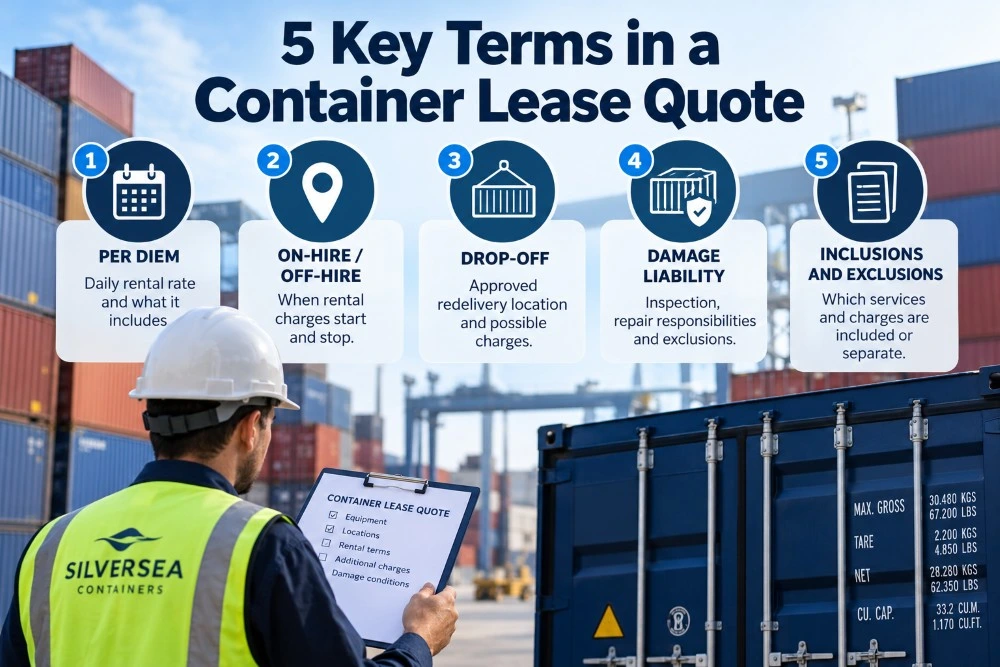
Per Diem: What Does the Daily Rental Rate Actually Cover?
In container leasing, per diem generally refers to the daily rental amount charged for the use of equipment. However, understanding the quoted rate requires more than knowing its numerical value.
Check the following:
- Is the rate quoted per container, per day?
- Which currency applies?
- Is there a minimum rental period?
- How are partial days treated?
- When does invoicing occur?
- Does the rate remain unchanged throughout the agreed period?
- What happens if the lease is extended?
- Are any additional services included in the daily charge?
A quote may also specify payment terms, credit requirements or security arrangements that affect the overall commercial commitment.
When does the per diem start?
The rental commencement event is commonly referred to as on-hire. Depending on the agreement, charges may begin at equipment collection, delivery, a documented handover or another expressly defined event.
The contract should identify the applicable trigger. For example, if collection is delayed or the container is made available before the planned operating date, the allocation of costs depends on the agreed conditions.
The commercial documents should make clear which party is responsible for any resulting rental exposure.
When does the per diem stop?
The end of rental is equally important.
Depending on the agreement, the termination of daily charges may be connected to:
- Physical redelivery to an approved location.
- Formal acceptance by the receiving depot.
- Issuance of an Equipment Interchange Receipt (EIR).
- Completion of a required off-hire process.
- Confirmation from the lessor.
- Another contractually defined event.
Do not assume that physically returning a container automatically ends the rental period. Ask which event formally stops the charge and what evidence confirms that it has occurred.
Per diem is not the same as detention or demurrage
These terms are frequently confused. Lease per diem is the daily rental amount established between the parties to a container leasing arrangement.
Detention and demurrage generally refer to charges associated with the use or retention of containers and cargo within carrier or terminal-related arrangements, according to the applicable tariff and contract.
Terminal storage and other logistics charges may also arise independently. The existence of a container lease does not automatically determine whether these additional charges apply or which party is responsible.
Drop-Off, Redelivery and Off-Hire Conditions
Redelivery arrangements can significantly affect the cost and operational flexibility of a container lease.
The term drop-off may refer to the physical return of equipment, an accepted redelivery location or a charge associated with returning a container to a particular depot. The quotation should clarify the intended meaning.
Check the approved redelivery location
Confirm:
- Which depot or locations are approved for return.
- Whether the container can be returned to a different location.
- Whether prior approval or an appointment is required.
- Whether any return quota or acceptance restriction applies.
- Who arranges and pays for transport to the depot.
- What happens if the planned return location cannot accept the equipment.
These conditions are particularly relevant when equipment is collected in one location and returned elsewhere. For more context, read our guide to standard vs one-way shipping container rental in Europe.
Understand possible drop-off charges
A drop-off charge may apply when equipment is returned to a specified destination or under particular commercial conditions.
The charge may be:
- Included in the agreed commercial package.
- Quoted as a separate amount.
- Conditional on the final redelivery location.
- Subject to additional confirmation.
- Not applicable to the proposed transaction.
There is no universal drop-off fee or charging structure across all container leases.
What to verify: Ask whether any drop-off or redelivery charge applies, how it is calculated and whether it is included in the quoted amount.
Confirm the off-hire procedure
Before accepting an offer, establish the complete return process. Who must notify the lessor? Does the depot require an appointment? Is an EIR needed? Can inspection or damage reporting affect the off-hire procedure? What happens if the depot refuses acceptance?
These questions help distinguish the physical return of equipment from the contractual end of rental.
As an industry reference, BIMCO’s BOXCHANGE 2016 is a standard container interchange agreement developed particularly for transactions between liner operators. Although it is not a universal leasing contract, its treatment of delivery and redelivery procedures illustrates why those arrangements require clear documentation.
Its provisions should not be interpreted as the standard commercial terms of SILVERSEA Containers or any other individual supplier.
What Is Included in the Quote? Identify Additional Charges
Container leasing quotations may include some logistics services while excluding others. A daily rate should therefore be evaluated alongside the costs of collecting, moving, handling and returning the equipment.
Depending on the transaction, relevant items may include transport, depot handling, lift-on/lift-off operations, cleaning, inspection, documentation, taxes and other location-specific charges.
Container lease quote: inclusion and exclusion matrix
Use the following matrix to identify responsibilities and costs that may sit outside the base rental rate.
| Item to Check | What to Confirm | Why It Matters |
|---|---|---|
| Collection and Delivery Transport | Who arranges transport and whether it is charged separately. | Transport costs can significantly affect the total lease cost. |
| Depot Handling | Which depot processing, handling or lifting operations are included. | Certain handling services may be invoiced separately. |
| Redelivery or Drop-Off | Approved return depot, redelivery conditions and potential charges. | The return location and conditions can change the effective cost. |
| Inspection | Whether inspection is required, who performs it and who pays. | Inspection requirements may continue through the return process. |
| Cleaning and Preparation | Required equipment condition at return and any applicable charges. | Additional cleaning or preparation may be needed before acceptance. |
| Documentation | Required records, documentation fees and responsible party. | Missing documentation can delay the formal closure of the lease. |
| Taxes and Local Charges | Applicable tax treatment, local charges and any exclusions. | Additional costs depend on the transaction and jurisdiction. |
The objective is not to assume that every item generates a charge. It is to identify which costs are included, separately payable, conditional or not applicable.
For UK and European operations, tax and customs treatment should be confirmed for the relevant parties, equipment movement and jurisdiction. A single quotation cannot establish universal rules for every European route.
Damage Liability: Condition, Inspections and Repair Claims
Damage provisions are among the most important parts of a container leasing agreement because they may create financial responsibilities beyond the quoted daily rental amount.
A quotation should be assessed together with the applicable agreement to understand how the parties address equipment condition, damage, repairs, contamination, loss and insurance.
Document the condition at collection
When collecting a container, confirm how the condition of the equipment is recorded.
Depending on the process, supporting evidence may include:
- An Equipment Interchange Receipt (EIR).
- An inspection report.
- Photographs of the exterior and interior.
- Records of existing damage.
- Dates, times and equipment identification numbers.
- Any required notification of defects.
The agreement should identify who performs the inspection, when defects must be reported and what happens if a condition discrepancy is discovered after handover.
Practical recommendation: Keep a dated record of the equipment’s condition at collection and retain all relevant documents until the return process and any associated claims are resolved.
Ordinary wear and tear vs chargeable damage
Normal operational wear and chargeable damage are not necessarily treated in the same way.
However, the distinction depends on the contractual provisions and any repair or inspection standards incorporated into the agreement.
Points requiring clarification may include:
- Ordinary wear and tear.
- Dents, corrosion and structural damage.
- Damage to doors, seals or locking components.
- Floor damage and contamination.
- Missing components.
- Pre-existing damage.
- Repairs carried out without prior authorisation.
- Damage identified during or after redelivery.
If the agreement incorporates a particular inspection or repair standard, ask for the exact reference and applicable version.
For example, Textainer’s 2022 annual report describes leasing practices involving repair responsibilities, ordinary wear and tear, insurance and optional damage-protection arrangements. These disclosures illustrate the types of provisions that may appear in container leasing agreements; they do not establish SILVERSEA Containers’ policies.
Who pays for repairs?
The quotation or agreement should clarify:
- Who assesses damage at return.
- Which damage is attributed to the lessee.
- What repair criteria and rates apply.
- Whether approval is required before repairs.
- How supporting evidence and estimates are communicated.
- How disagreements or disputed charges are handled.
A general requirement to return a container in «good condition» may be insufficient to explain the complete process.
Insurance, damage protection and total loss
Insurance obligations and protection arrangements should be reviewed independently from the daily rental rate.
Depending on the proposed contract, relevant considerations may include:
- Responsibility for arranging insurance.
- Required types and levels of cover.
- Applicable deductibles and exclusions.
- Indemnity obligations.
- Optional damage-protection arrangements, if offered.
- Treatment of theft, loss or total loss.
- Contractual valuation methods for equipment that cannot be repaired.
Do not assume that damage protection is included or that insurance eliminates all contractual liability.
What to verify: Request written confirmation of the applicable responsibilities, exclusions and claims procedures before accepting the quotation.
How to Compare the Estimated Total Cost of Two Lease Quotes
Once the contractual responsibilities are clear, the next step is to compare the expected financial commitment. The lowest per diem does not necessarily produce the lowest overall cost.
A useful comparison separates three elements.
A. Base rental cost
For a straightforward per-container daily-rate arrangement, the starting calculation is:
Base rental cost = Billable rental days × Daily rate × Number of containers
The actual amount must reflect any minimum term, billing convention, rate changes, extensions or other provisions in the agreement.
For example, the number of billable days may differ from the number of days the container is physically used if the contractual on-hire and off-hire events do not match the operating schedule.
B. Confirmed and foreseeable additional costs
Add the charges that are documented and reasonably expected for the proposed transaction, such as:
- Collection transport.
- Delivery or repositioning.
- Agreed drop-off charges.
- Separately billed depot handling.
- Inspection or documentation fees.
- Applicable taxes and other confirmed charges.
Avoid counting the same service twice when it is already included in the base rate or another quoted amount.
C. Conditional financial exposure
Certain costs may depend on future events rather than being payable in every transaction.
Examples include:
- Additional rental days caused by delayed redelivery.
- Damage or repair claims.
- Cleaning charges arising from return condition.
- Redelivery at a different depot.
- Contractual early termination charges.
- Insurance deductibles or loss-related responsibilities.
These amounts should not be presented as guaranteed costs. Instead, record the circumstances that could trigger them, any contractual limits and which party would be responsible.
A practical comparison is therefore:
Estimated planned cost = Applicable base rental cost + Confirmed additional charges + Foreseeable operating costs not already included
Then assess conditional financial exposure separately. This approach allows procurement teams to compare quotations without confusing predictable expenditure with uncertain contractual risk.
Why the cheapest daily rate may not be the best offer
Consider two hypothetical proposals without assigning specific prices.
- Quote A has a lower daily rate, but requires return to a particular depot, excludes collection transport and includes a conditional drop-off charge.
- Quote B has a higher daily rate, but offers a more convenient confirmed redelivery arrangement and includes services that would otherwise need to be arranged separately.
The better commercial option depends on the actual operating route, expected duration, included services and contractual responsibilities.
Neither quote can be judged on the daily figure alone.
Other Terms That Can Change the Effective Offer
Several less prominent contractual details may influence cost, risk and operational flexibility.
Quote validity
Check the deadline for accepting the offer and whether equipment availability, rates or locations are subject to reconfirmation.
Minimum duration and extensions
Identify any minimum lease period, renewal provisions, extension rates and early termination conditions.
A lease that appears flexible at the quotation stage may involve additional obligations under the governing documents.
Payment and credit conditions
Review invoicing frequency, payment deadlines, credit arrangements, deposits or other security requirements where applicable.
Currency and conversion
Confirm the invoicing currency and whether conversion arrangements or bank charges may affect the payment amount.
This may be particularly relevant where contracting parties operate in different countries.
Permitted equipment use
Check whether the proposed agreement places restrictions on cargo, routes, geographical areas, operating environments or intended applications.
Contracting entity and governing documents
Verify the legal entity issuing the quotation and the documents that will govern the agreement.
Make sure the commercial conditions discussed with the sales team are reflected in the relevant documentation.
End-of-term alternatives
Some projects may benefit from discussing a separate commercial arrangement after the initial period of container use.
For example, SILVERSEA Containers also provides container buyback solutions for qualifying purchase-and-buyback transactions.
However, a buyback arrangement is distinct from a standard lease and should never be assumed to form part of a quotation unless it is expressly offered and documented.
Container Lease Quote Comparison Checklist
Before selecting a supplier, use this checklist to review both proposals against the same operational requirement.
| Comparison Field | What to Verify | Why It Matters |
|---|---|---|
| Equipment and Quantity | Type, size, condition, specification and number of units. | Different equipment may not be commercially comparable. |
| Collection | Location, date, handover requirements and on-hire trigger. | Determines when use and billing begin. |
| Per Diem | Currency, daily rate, billing basis and minimum duration. | Establishes the base rental commitment. |
| Off-Hire | Rent-stop event, notice and required evidence. | Determines when daily charges end. |
| Redelivery | Approved depot, alternatives and acceptance conditions. | Affects operational feasibility and possible costs. |
| Drop-Off Charges | Applicability, calculation and responsible party. | May change the effective rental cost. |
| Transport and Handling | Included services, exclusions and charging basis. | Determines the full service scope. |
| Condition and Damage | Inspection standards, repair responsibilities and disputes. | Defines potential financial exposure. |
| Insurance and Loss | Required cover, exclusions and loss treatment. | Clarifies contractual risk. |
| Taxes and Other Charges | Transaction-specific treatment and exclusions. | Identifies additional financial obligations. |
| Documents and Entities | Applicable agreements, schedules and contracting parties. | Establishes which provisions govern the transaction. |
A useful comparison should make it possible to answer three questions:
- Are both suppliers quoting the same equipment and operational requirements?
- What will the transaction cost under the expected operating plan?
- Which responsibilities or conditional charges remain outside that estimate?
If these questions cannot be answered from the documentation, request clarification before treating the quotation as complete.
Questions to Ask Before Accepting a Container Lease Quote
The following questions can be copied into an email and adapted to the equipment, route and planned duration.
- What exact equipment is included? Please confirm container type, dimensions, quantity, specifications and condition.
- When does the per diem begin and end? Which events formally establish on-hire and off-hire?
- What billing conditions apply? Please confirm the currency, daily-rate basis, minimum term, invoicing schedule and any extension provisions.
- Which collection and redelivery locations are approved? Are they confirmed for this transaction or subject to availability and additional approval?
- What return procedures are required? Are appointments, prior notices, quotas, EIRs or inspections necessary?
- Which services and charges are included? Please identify any exclusions relating to transport, depot handling, cleaning, inspection, documentation, drop-off charges and taxes.
- How is equipment condition documented? What records must be completed at collection and return?
- How are damage and wear and tear assessed? Which standards, repair procedures and dispute mechanisms apply?
- What insurance obligations exist? Who arranges cover, and are deductibles, exclusions or damage-protection arrangements specified?
- Which documents govern the lease? Please identify the quotation, lease schedule, master agreement and any incorporated standards or additional conditions.
- How long is the quotation valid? Are the equipment, rate, collection location and redelivery arrangements confirmed or subject to reconfirmation?
Requesting these details in writing creates a clearer basis for evaluating the offer and helps reduce misunderstandings during the transaction.
Share the packed dimensions, weight, handling method and location with SILVERSEA Containers.
Request a Container Leasing Quote from SILVERSEA Containers
A clear quotation request is the starting point for a well-planned container leasing operation.
Rather than requesting an isolated daily rental figure, provide enough information for the supplier to understand the intended equipment movement and period of use.
Useful information includes:
- Container type and quantity.
- Preferred collection location and target date.
- Expected rental duration.
- Intended route or operating requirements.
- Proposed redelivery location.
- Any special equipment or technical requirements.
- Company and contracting details.
At SILVERSEA Containers, we offer maritime container leasing solutions for different operational requirements, including short-term, long-term and one-way arrangements.
Our team can review your requirements and help clarify the applicable equipment options, availability and commercial conditions for the proposed transaction.
Whether you are comparing existing offers or planning a new operation, understanding the per diem, redelivery process, inclusions and potential additional charges will help you make a more informed decision.
Request a container leasing quote from SILVERSEA Containers and discuss the equipment, route and rental terms that best fit your operation.