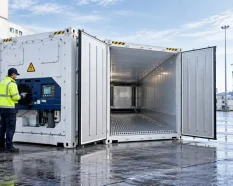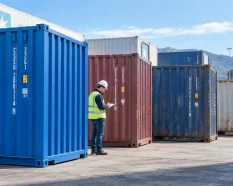














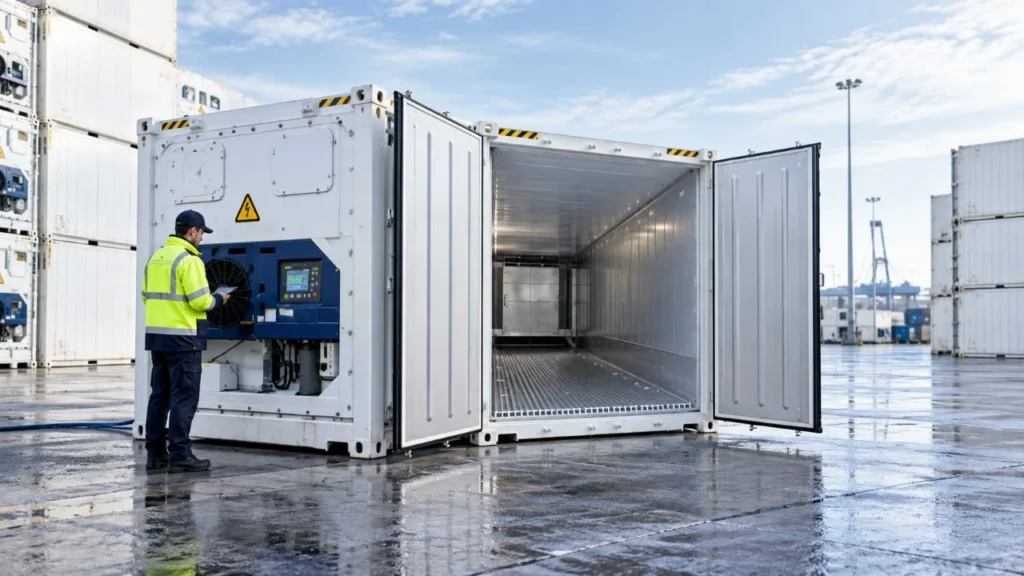
A reefer container can be a practical temporary cold-storage option in Europe when four points are confirmed before delivery: the required temperature and product profile, the available electrical supply, the site and delivery conditions, and the monitoring and service responsibilities. A reefer is an actively refrigerated ISO thermal container—not simply an insulated box—so suitability depends on the allocated unit, the product and the operating environment.
This guide focuses on stationary, temporary deployment for uses such as seasonal capacity, warehouse overflow and planned site work. It does not replace a product-specific technical review or local advice. When requesting a quote from SILVERSEA Containers, provide enough information for the unit and site requirements to be assessed together.
When a reefer rental is the right temporary cold-storage option
A refrigerated container may suit businesses that need additional cold capacity without committing to a permanent building or refrigeration installation.
Typical temporary applications include:
- Seasonal stock peaks for food and beverage operations
- Temporary warehouse overflow during promotions or higher-demand periods
- Capacity while a cold room or distribution facility is undergoing planned maintenance
- Short-term storage for events, catering operations or retail campaigns
- Temporary holding capacity during a site move, refurbishment or operational change
The decision is less straightforward if the site cannot provide a suitable power supply, the product requires a tightly controlled process, or delivery and positioning are not practical. For regulated or particularly sensitive products, suitability, procedures and documentation should be reviewed specifically for the product, unit and jurisdiction rather than assumed from the fact that the equipment is refrigerated.
Quick feasibility test: can the site provide the required electrical supply, accommodate the container and its doors, receive the delivery equipment, and support the agreed monitoring and response process? If any answer is uncertain, resolve it before requesting a final quote.
Start with the product and temperature requirement
The requested setpoint is not the same as the proven temperature of the product. A refrigeration unit may be able to maintain a selected air temperature under specified conditions, but product temperature also depends on loading temperature, packaging, airflow, quantity, door openings and ambient conditions.
Include the following information in the initial enquiry:
- Product type and any relevant storage sensitivity
- Required setpoint or temperature range in °C
- Whether products arrive already chilled or frozen
- Estimated quantity, pallet configuration and stock turnover
- Expected loading and unloading frequency
- Typical door-opening pattern and duration
- Required rental period and any peak-use dates
- Whether fresh-air exchange, humidity control or another option may be needed
Temperature capability is model-specific. For example, a Daikin LXE specification lists an internal range of -30 °C to +30 °C for that product family, but this should not be treated as a universal rental specification or a guarantee for every cargo application. The capability, pull-down performance and operating limits of the allocated unit must be confirmed for the intended conditions.
Reefer versus an insulated container
An insulated container helps reduce heat transfer but does not actively generate cooling. A reefer includes a refrigeration system and requires an electrical supply to maintain the selected conditions. If active temperature control is central to the operation, an insulated unit should not be treated as an equivalent substitute without a separate technical assessment.
Power checklist: What to confirm before delivery
Reefer containers are electrically powered, and the required supply is specific to the refrigeration unit and its configuration. Do not assume that a standard socket, a particular plug, a generator or a specific cable length will be suitable.
Ask the site team or electrician to confirm:
- Available voltage and frequency
- Whether three-phase power is available at the proposed position
- Socket and plug compatibility with the allocated unit
- Available electrical capacity and protective devices
- The distance between the connection point and the container
- The proposed cable route and protection from traffic or weather
- Who is responsible for checking, connecting and safely isolating the supply
- Whether backup power is required for the site’s risk-management plan
As an illustration of why confirmation matters, a Carrier PrimeLINE manual describes a base unit operating on nominal 380/460 V, three-phase, 50/60 Hz power, with an optional transformer for other nominal voltage ranges. This is a manufacturer example, not SILVERSEA Containers’ standard rental specification or a statement of the required load for every reefer.
The quote request should therefore include the site’s electrical details and, where possible, a photograph or specification of the available socket. The assigned unit, model configuration and connection requirements can then be checked before delivery.
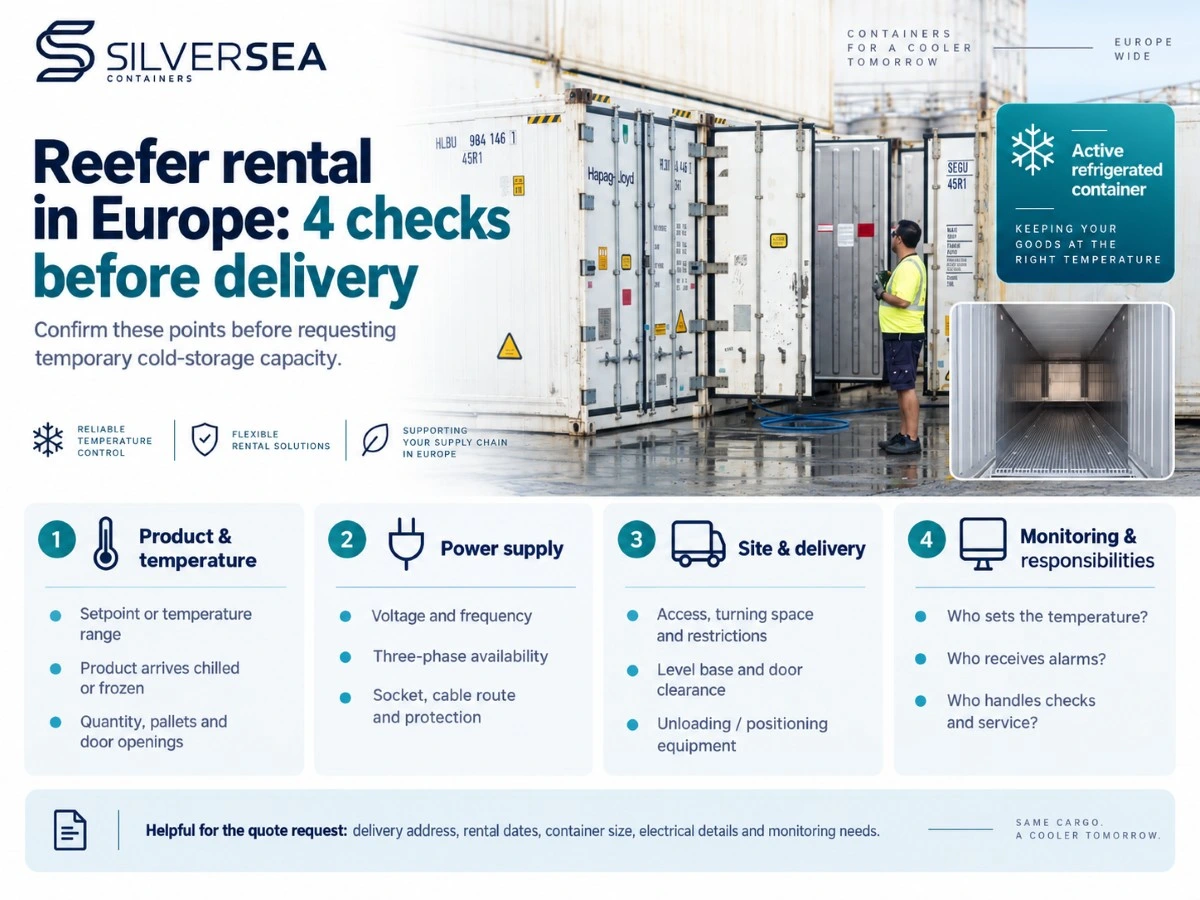
Site and delivery checklist
A technically suitable reefer can still be impractical if the delivery route or placement area has not been reviewed. Site planning should cover the full journey from the public access point to the final operating position.
Check the following before confirming the arrangement:
- Exact delivery address, country and contact details for the site
- Vehicle access, turning space, height restrictions and road approach
- Available space for the container, including door operation clearance
- A level and suitable base for the proposed placement
- Clearance around the refrigeration machinery for operation and service access
- Safe routing for electrical cables and protection from vehicles or pedestrians
- Exposure to weather and any drainage considerations relevant to the site
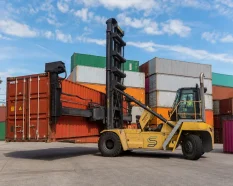
- The equipment and personnel available for unloading or positioning
- The planned route for stock, pallets and handling equipment
- Site operating hours, access instructions and delivery restrictions
These are practical planning checks, not universal legal requirements. Local access, workplace safety, electrical and planning rules vary between countries and sites. The customer should identify any local approvals or professional inspections that may apply to the proposed placement.
Monitoring, alarms and operating responsibility
A clear responsibility split prevents avoidable disputes when a temperature alarm, power interruption or service issue occurs. Monitoring and operating arrangements should be written into the rental scope rather than inferred from the word “reefer”.
Responsibility areas to agree before deployment
| Area | Questions to resolve |
| Temperature control | Who sets the setpoint, and who may change it? What operating conditions and product limits apply? |
| Monitoring and records | Is local or remote monitoring required? Are data logs, alarm visibility or connectivity included for the allocated unit? |
| Alarm response | Who receives alarms, during which hours, and what action is expected after a power or temperature deviation? |
| Routine checks | Who checks the display, doors, power connection and general condition during the rental? |
| Maintenance and call-outs | Who contacts the service team, and what process applies if the unit requires attention? |
| Pre-delivery condition | What inspection or operational status will be confirmed before use, and what information will be supplied? |
| End of rental | Who removes stock, disconnects the unit and prepares the site for collection? |
Remote monitoring, alarm visibility, data recording, fresh-air exchange and voltage or plug options may be available on some refrigeration configurations, but they are not standard assumptions. Carrier identifies these types of features as configuration options. Availability must be confirmed for the allocated unit and agreed service package.
Europe-specific compliance and safety boundaries
Europe is not one uniform operating environment. Electrical, workplace safety, food-storage, access and planning requirements may differ by country, municipality, site and product. An EU-level rule should not automatically be presented as a site-permit requirement.
Refrigeration servicing and refrigerant handling can involve regulated responsibilities. Regulation (EU) 2024/573 covers fluorinated greenhouse gases and includes refrigeration units of intermodal containers within relevant provisions. The practical obligations and allocation of responsibility depend on the equipment, the country and who controls or services it. The rental agreement should clearly define who arranges servicing, recovery and competent technical intervention where required.
If controlled-atmosphere equipment is requested, treat it as a separate technical and safety topic. Controlled-atmosphere containers can create low-oxygen entry hazards and require specific ventilation and entry procedures. Controlled atmosphere is not a default feature of a reefer rental and should be separately confirmed with appropriate safety procedures.
Share the packed dimensions, weight, handling method and location with SILVERSEA Containers.
What to include in a reefer rental quote request
A complete brief helps the supplier evaluate the application and reduces clarification rounds. Copy and complete this checklist before sending your enquiry:
- Country, city and full delivery address
- Required rental start and end dates, including any flexibility
- Preferred container size, such as 20 ft or 40 ft, if known
- Product type, target setpoint or range, and product loading temperature
- Estimated quantity, pallet layout and expected door-opening frequency
- Available voltage, frequency and three-phase supply details
- Photographs or specifications of the proposed electrical socket, where possible
- Delivery route, placement area, door clearance and unloading constraints
- Available forklift, crane or other positioning equipment, if relevant to the site plan
- Monitoring, data recording, alarms or remote-connectivity requirements
- Site contact, operating hours and emergency or service contact details
- Any special requirements, including fresh-air exchange, humidity control or controlled atmosphere
Do not worry if every technical field is not known. The purpose of the initial request is to provide the operational facts available and identify what must be verified. Country and site location are particularly important because delivery planning, local requirements and service arrangements can vary.
Rental versus longer-term container leasing
A temporary static cold-storage requirement is usually evaluated around deployment dates, site readiness and the agreed service scope. If the need is expected to continue for a longer period or forms part of a broader container fleet strategy, a leasing discussion may be more appropriate than a short-term rental.
The commercial structure, equipment allocation and responsibilities still need to be confirmed for the specific requirement. For a broader comparison of longer-term arrangements, see maritime container leasing.
Request a reefer rental quote with the site details
The fastest route to a useful assessment is to send the product and temperature brief together with the power, site and responsibility information.
SILVERSEA Containers can review the request details and clarify what needs to be confirmed for the proposed unit and location; this does not constitute automatic site approval, compliance confirmation or a promise of availability.
Use the checklist above and Request a reefer rental quote to submit your requirement.