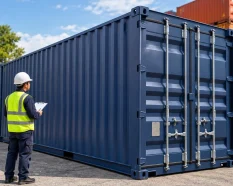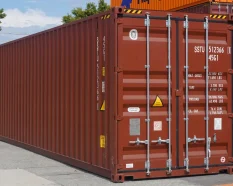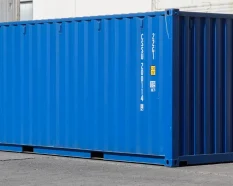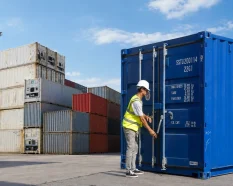















Before booking a shipping container delivery, check the complete vehicle route, unloading space, ground conditions and final placement. The container footprint is only part of the assessment: the vehicle and handling equipment need their own operating space, and the ground must be assessed for the proposed movement.
This shipping container delivery site checklist helps UK and European businesses prepare the information needed for a delivery quotation and site review. Photos and measurements support that review; they do not replace a lifting plan or confirm that the site is suitable.
Shipping container delivery checklist at a glance
Send current photographs, an annotated site plan and the details below before agreeing the delivery arrangements. If you have not selected a unit, start with the guide to choosing from a shipping container catalogue.
| Check | Information to send | What to confirm |
| Container and load | Type, size, quantity and gross mass; say whether it is empty or loaded. | Vehicle and handling method for the identified unit and load. |
| Access route | Gate and route measurements, turns, height restrictions and route photographs. | Clearance, turning space and approach for the proposed vehicle. |
| Unloading area | A plan showing working space, nearby obstructions and site traffic. | Space for the equipment to set up, operate and leave. |
| Ground conditions | Surface, slopes, drainage, excavation and recent weather effects. | Suitability for vehicle, unloading equipment and final container position. |
| Overhead and buried hazards | Known power lines, services, covers, drains, pits and voids; flag uncertainty. | Constraints that affect the route or equipment positioning. |
| Placement and doors | Final position, door direction, access during use and proposed supports. | Placement and support arrangements for the unit and intended use. |
| Timing and site contact | Address, entrance, date window, restrictions and an on-site contact. | Booking requirements, site coordination and changes before dispatch. |
Share the packed dimensions, weight, handling method and location with SILVERSEA Containers.
Check the full access route
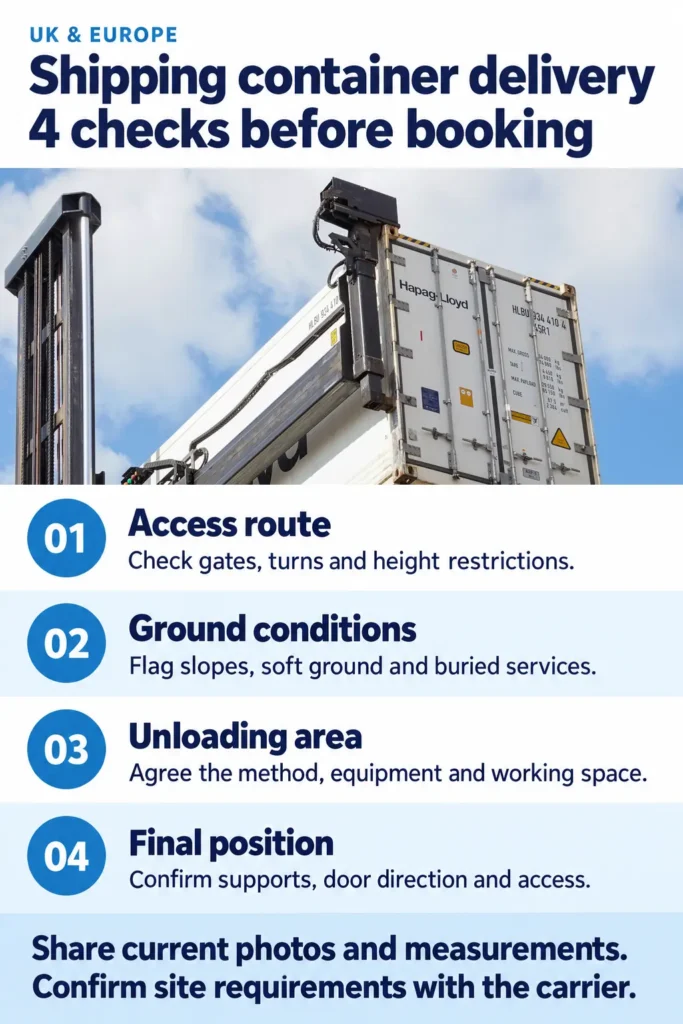
Follow the route from the public-road approach to the proposed unloading area. Record restrictions along the whole journey through the site, including anything that could prevent the vehicle from leaving after delivery.
Gates, turns and vehicle clearance
Measure the narrowest gate or passage and note tight bends, kerbs, traffic islands, dead ends, restricted visibility and reversing requirements. Record height restrictions where the truck or unloading equipment will pass or operate.
Ask the carrier to confirm the vehicle dimensions, turning requirements and working space for the proposed delivery. There is no single clearance figure that applies to every container delivery: a different truck, load or unloading method can change the requirement.
Photograph the entrance in context and include the route beyond it. A short route video and a sketch with measured constraints are more useful than a close-up of an open gate.
Overhead and nearby obstructions
Identify overhead power lines, branches, canopies, signs, lighting, building projections and pipework. Also show walls, loading bays, parked vehicles, stored materials and pedestrian areas near the route or unloading position. Keep unverified clearances clearly marked for review.
Slopes, surface changes and weak edges
Describe ramps, gradients, uneven surfaces, soft verges, drainage channels, culverts and inspection covers. Include temporary works or traffic arrangements. Send updated evidence if excavation, construction activity or weather has changed the route since the photographs were taken.
Check the ground and final position
Ground for the vehicle and unloading equipment
Describe the surface at the approach, unloading area and final container position: concrete, asphalt, compacted material, gravel or untreated ground. Note standing water, poor drainage, soft edges, recent excavation and changes after heavy rain or frost.
The assessment must consider the delivery vehicle and unloading equipment as well as the container. Equipment can apply concentrated loads through wheels or stabilisers. A paved or apparently firm surface is not, by itself, evidence of sufficient bearing capacity; flag any uncertainty for the responsible professional or site authority.
Underground services and structures
Mark known services, drains, covers, pits, basements, voids and backfilled areas on the plan. Say where information is incomplete. These features can affect the vehicle route and equipment positioning, even when the surface looks clear.
Container supports and door orientation
Show the final position and the end where the doors should face. Allow for access to the doors during use and for their opening, alongside any space needed for staff or handling equipment.
Agree the final support arrangement with the supplier or a competent professional before delivery. It should suit the identified unit, ground conditions and intended use. This checklist does not specify foundations, support spacing or a universal bearing-capacity requirement.
Agree the unloading method before booking
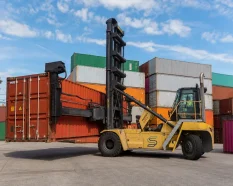
Depending on the site and unit, the proposed method may involve a truck-mounted crane, a separate crane, a sidelifter, a reach stacker or suitable equipment supplied by the customer. Availability and suitability need confirmation for the location and operation.
Tell the supplier whether the container will be empty or loaded, and provide its gross mass and relevant handling information. Do not assume that a forklift, crane or other arrangement used for an empty unit can handle a loaded one. Describe on-site equipment without treating it as an approved unloading solution.
For lifting operations in Great Britain, HSE guidance on planning and organising lifting operations explains that planning must address the foreseeable risks and use appropriate competence. Agree who is responsible for the lifting arrangements, equipment, supervision and site controls before booking.
What should the delivery quote include?
Ask for the quotation to identify the equipment and the services required to get it into the agreed position. Check:
- The container specification and any depot release or loading services included.
- Transport to the named delivery address and site entrance.
- Unloading and positioning, where included and confirmed for the site.
- Access assumptions, exclusions and customer site-preparation responsibilities.
- Applicable taxes and any agreed waiting-time, failed-delivery or rescheduling terms.
- The delivery window and the information required before dispatch.
For the wider price comparison, see shipping container cost in Europe. Compare the quoted scope rather than treating an equipment-only price as the cost of a delivered and positioned unit.
If the container is rented, plan for collection as well as delivery. Keep the future access route in mind and agree the collection and return scope separately; the guide to shipping container rental in Europe explains standard and one-way return arrangements.
Delivery-day checks
The named site contact should recheck the arrangements before arrival. Confirm that:
- Gates, the vehicle route and the unloading area are clear and available.
- The placement marker and door orientation still match the agreed plan.
- Ground conditions and known hazards match the information supplied.
- Pedestrian and vehicle controls are in place for the delivery area.
- Communication with the driver and unloading team has been agreed.
- Weather, excavation, restrictions or other changes have been reported.
If traffic marshals or signallers are required, agree who supplies them and use appropriately trained personnel. Keep people who are not involved clear of the operation. HSE’s workplace transport guidance provides relevant planning guidance for Great Britain.
If conditions no longer match the reviewed information, stop and contact the responsible parties for reassessment. Do not ask the driver or lifting team to improvise around changed ground conditions or an obstruction.
Check placement and handover
Once the delivery team confirms that it is safe to approach, carry out a practical handover check against the order and agreed delivery scope:
- Check the identity of the delivered unit against the order or delivery record.
- Confirm its position, door orientation and access match the agreed arrangement.
- Photograph its visible condition and record any apparent damage or discrepancy.
- Confirm the agreed unloading or positioning work and handover documents.
Report concerns through the supplier’s delivery-reporting process. A visual handover check records the condition and placement observed; it does not replace a required technical assessment.
Send the site information with your enquiry
When contacting SILVERSEA Containers, include the full address, annotated route plan, current photographs, container and load details, preferred timing and a named site contact. Flag uncertain ground conditions or unverified services so they can be considered before delivery arrangements are agreed.
Request a shipping container quote with your site details and explain whether you need transport, unloading, positioning or a combination. Ask the team to confirm the available options for your location and the scope included in the proposal.
Frequently asked questions
It depends on the delivery vehicle, unloading equipment, container and route. The container footprint does not include the space needed to turn, set up equipment and leave the site. Ask the carrier to confirm the required clearances and operating area.
Not automatically. Ask the quotation to identify transport, unloading and positioning separately, together with access assumptions, exclusions and customer responsibilities. Confirm the full scope before booking.
State the preferred orientation and mark it on the placement plan before dispatch. The final arrangement must work with the unloading method, available space and intended use of the container.
Report the change before dispatch or arrival. Rain, flooding, frost or excavation can alter access and ground conditions. The responsible parties need to reassess the proposed movement and may need to reschedule it.
Ask the supplier or carrier to confirm the handling method and who supplies the equipment. Do not hire equipment solely on the basis of a generic checklist or a previous delivery; suitability depends on the specific unit, load and site.
No single set of rules covers every location. HSE guidance is relevant to Great Britain; Northern Ireland has its own framework and HSENI guidance. For other European sites, check applicable national and local requirements. A site checklist is not a lifting plan or regulatory approval.