













To request a useful shipping container quote in Spain, tell the supplier whether you want to buy or lease, what the container will be used for, the quantity, preferred size and type, acceptable condition, exact delivery or collection location, target dates, site access and unloading requirements.
- Ask for the equipment price and the delivery operation to be shown clearly, including VAT, transport, unloading, optional work and quote validity where applicable. If you do not yet know the correct container, describe the project rather than guessing a specification.
This guide concerns the purchase or leasing of the physical container. It is not a guide to obtaining an ocean-freight rate for moving cargo from one port to another. If your requirement includes an international shipment, tell the supplier or logistics partner from the start because the route, cargo and carrier-acceptance requirements become part of the decision.
Start by defining what you are asking the supplier to quote
The phrase “shipping container quote” can describe several different services. A buyer may want a container delivered to a site in Spain for storage, a company may need equipment for international transport, or an operator may want a short- or long-term lease. Those are not interchangeable requests.
- Purchase: you want to acquire the container as an asset for storage, transport, conversion or another defined use.
- Lease or rental: you need the equipment for a stated period, route or project, with delivery, collection or return conditions to be agreed.
- Ocean freight: you want a rate to move cargo between an origin and destination. This may involve a carrier-owned container and transport charges rather than purchasing the equipment itself.
The SILVERSEA Containers online quote form starts with core fields such as country, city, container type and quantity. Preparing the operational details below helps the sales team understand what those fields mean in practice and reduces avoidable follow-up questions.
The details to prepare before requesting a container quote in Spain
1. Purchase, lease or one-way requirement
State the commercial route first. For a lease, include the expected start date, duration and intended return or end location. For a purchase, explain whether the unit will remain at one site, be modified or enter an intermodal transport operation. If you are comparing purchase and leasing, say so; the supplier can then assess both alternatives against the same project information.
2. Intended use
A container suitable for static storage is not automatically the right unit for international cargo transport, temperature-controlled use, frequent daily access or a modification project. Describe what will go inside, how often the doors will be opened, whether people will work in or around the unit, and whether the container will move after delivery. This is more useful than asking only for the cheapest available box.
3. Quantity, size and container type
Include the number of units and any known size or equipment preference. Common requests include 20ft or 40ft dry containers, 40ft High Cube units, reefers, open-top containers and flat racks. If the requirement is uncertain, provide the cargo or storage dimensions and allow the supplier to recommend an option.
You can review the main equipment families on the SILVERSEA Containers range of maritime containers before submitting the request. Final dimensions, weights and operating characteristics must still be confirmed against the selected unit’s data plate or technical sheet.
4. Acceptable condition and inspection expectations
Do not use “new” or “used” as the only condition description. Ask what the supplier’s condition label means, whether representative or unit-specific photos are available, what inspection has been carried out and which defects are acceptable for your intended use. Terms such as One Trip, Cargo Worthy, Wind and Water Tight, IICL and As-Is are used in the market, but their commercial interpretation and any warranty can vary by supplier.
If the container will be used in international transport, ask the supplier to confirm its CSC status and examination position for the intended operation. The International Maritime Organization explains that containers used in international transport fall within the CSC safety-approval framework. For identification, the BIC size and type code helps distinguish a container’s dimensions and equipment characteristics; neither marking replaces a condition inspection or route-specific acceptance check.
5. Exact delivery or collection location
Provide the country, municipality and full postcode, then clarify whether the unit will be collected from a depot or delivered to a final site. If it must leave Spain for another EU country or the UK, identify the actual destination rather than asking for a domestic Spanish delivery price. Cross-border transport, documentation and tax treatment should be confirmed for the specific movement.
6. Site access, unloading and final positioning
The delivery postcode is not enough to plan the last metres of the operation. Share photographs or video of the approach and placement area, together with gate width, height restrictions, turning space, road surface, slope and overhead obstacles such as cables, branches or structures.
State whether the site has suitable unloading equipment or whether the supplier must quote delivery and unloading. Also explain the final orientation of the doors and how close the unit must be positioned to buildings, fences or other containers.
7. Required date and degree of flexibility
Give a target delivery or collection window, not only “as soon as possible”. Mention any immovable site date, crane booking, shutdown, vessel cut-off or project phase that affects the operation. Availability, depot location and transport capacity can vary, so the quote should state its validity and any assumptions about timing rather than relying on an informal estimate.
8. Cargo and technical requirements
For cargo or machinery, send packed length, width and height, gross mass, photographs or drawings, support footprint, centre of gravity where relevant, and the proposed loading and unloading method. For temperature-controlled use, provide the target temperature range, product, operating environment, electrical supply and monitoring expectations.
Mention liquids, batteries, dangerous goods, contamination risks or other regulated materials at the beginning; suitability and compliance must be evaluated for the cargo, route and operation rather than assumed from the container type alone.
9. Modifications and accessories
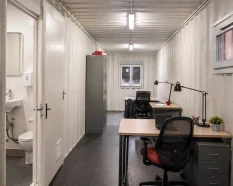
List any required doors, lockboxes, ventilation, lighting, electrical work, shelving, ramps, insulation, paint or internal fit-out. Separate essential modifications from optional preferences. This allows the supplier to distinguish the base container from additional work and to identify when a technical review is needed before pricing.
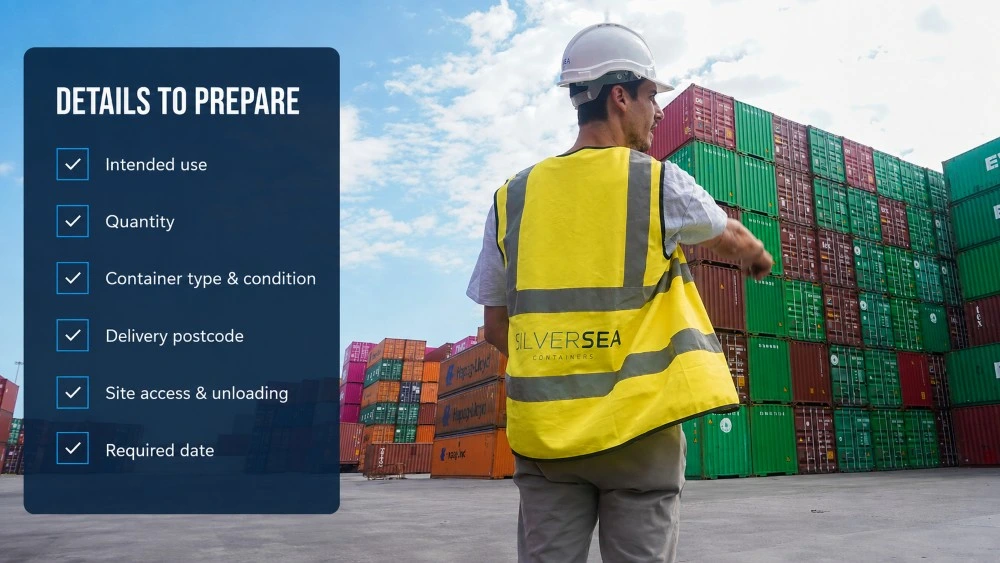
Quote-preparation checklist
Use the following checklist as the information pack for a shipping container supplier in Spain.
| Requirement | Details to send | Why it affects the quote |
|---|---|---|
| Commercial route | Purchase, short-term lease, long-term lease or one-way requirement | Changes the pricing basis, responsibilities and end-of-term conditions |
| Use | Storage, transport, machinery, cold storage, modification or another purpose | Determines the equipment and condition that may be suitable |
| Equipment | Quantity, preferred size, type and acceptable condition | Allows a like-for-like availability and price check |
| Location | Collection depot or full delivery postcode and final destination | Transport depends on the actual movement, not only the region |
| Site | Access measurements, approach photos, surface, obstacles and final position | Affects vehicle choice, unloading method and feasibility |
| Timing | Required window, flexibility and lease duration if applicable | Availability and transport capacity change by date and depot |
| Cargo | Dimensions, weight, loading method, temperature or regulated characteristics | Special equipment and compliance checks may be required |
| Optional work | Modifications, accessories, inspection or documentation requested | Separates the base unit from additional scope |
What a complete shipping container quote should clarify
A low headline price is not enough to compare offers. Ask the supplier to make the scope visible so that the container price is not confused with the total project cost.
- Equipment identification: container type, size, quantity, condition or grade, and depot or location where relevant.
- Price basis: price per unit and total equipment price, including the currency used.
- Taxes: whether VAT or any other applicable tax is included or excluded.
- Transport: collection or delivery origin, destination and what the transport charge covers.
- Unloading and positioning: whether unloading is included, what method is assumed and any site-access conditions.
- Additional work: modifications, accessories, inspection, cleaning or documentation priced separately.
- Timing and validity: availability assumptions, expected scheduling process and the period for which the commercial offer remains valid.
- Payment and reservation: payment milestones and what, if anything, reserves the unit or delivery slot.
- Condition and acceptance: inspection evidence, agreed acceptance criteria, exclusions and any warranty stated by the supplier.
- Lease-specific terms: duration, billing period, return location, collection, extension, early return, damage and cleaning conditions.
Key comparison rule: the base container price and the total project cost are not the same. Transport, unloading, positioning, site preparation, modifications and taxes may sit outside the unit price unless the quote states otherwise.
How to compare quotes from container suppliers in Spain
Compare the same requirement, not two different interpretations of it. Before choosing a supplier, check that each offer refers to the same container type, size, condition, delivery point, unloading responsibility and date window.
- Ask whether the quoted photos and inspection information refer to the actual unit or only to a representative example.
- Check whether the container is suitable for the intended use rather than relying on a generic condition label.
- Confirm where the equipment is located and whether the transport price is based on that depot.
- Separate price differences caused by condition, delivery distance, unloading or modifications.
- Check VAT treatment, currency, quote validity, payment terms and stated exclusions.
- For leasing, compare the full period and end-of-term obligations, not only the periodic rate.
- For transport use, confirm the required documentation, CSC position and acceptance by the relevant carrier or operator.
A professional comparison may reveal that the lowest unit price is not the lowest delivered or operational cost. It may also reveal that a more expensive offer includes transport, unloading, inspection or a condition level that another quote excludes.
Three ready-to-send quote request examples
- Example 1: purchase for static storage in Spain
We would like to purchase one used 20ft dry container for static storage at [full postcode, municipality, Spain]. It will store [materials] for approximately [period]. We need the unit to be suitable for dry storage and would like the supplier to explain the proposed condition grade, inspection evidence and any warranty. Access photographs and measurements are attached. Please quote the container, transport, unloading and VAT separately, and state the offer validity and expected scheduling process.
- Example 2: temporary lease
We require [quantity] [preferred size/type, if known] containers for temporary storage at [postcode and city] from approximately [start date] for [duration]. The site [does/does not] have unloading equipment. Please include delivery, collection or return arrangements, minimum period, extension and early-return conditions, damage/cleaning responsibilities, taxes and quote validity. We can provide site-access photographs and the final placement plan.
- Example 3: specialised equipment or industrial cargo
We need a container solution for [cargo/application]. Packed dimensions are [L x W x H], gross mass is [kg], and loading/unloading will be carried out by [method]. Drawings and photographs are attached. The proposed route or location is [origin/destination], with a target date of [date]. Please assess the appropriate equipment type, condition, transport suitability, documentation and any operational restrictions before quoting.
What if you do not know which container to request?
You do not need to select a container type before speaking to a supplier. A stronger request may be: “We need to store 18 pallets outdoors for six months in Zaragoza, with weekly forklift access and no crane on site.” That gives the supplier useful facts about capacity, duration, access and delivery.
When the equipment is for cargo, provide the packed dimensions, total weight, handling method, route and special characteristics. When it is for static use, provide the storage volume, access frequency, exposure, security needs and site constraints. The recommendation can then begin with the real application rather than a catalogue label.
Request a quote from SILVERSEA Containers
SILVERSEA Containers offers purchase and leasing routes for standard and specialised maritime containers, including dry, reefer, open-top and flat-rack equipment. Availability, condition, depot and delivery arrangements depend on the requested location, quantity, date and operating requirements.
Use the online quote form to provide the country, city, container type and quantity. If part of the specification is still unknown, share the intended use, location and timing with the sales team so the equipment and logistics can be assessed before the offer is finalised.
Request a shipping container quote in Spain with your project details
Share the packed dimensions, weight, handling method and location with SILVERSEA Containers.
Faqs
Yes. State the intended use, quantity, cargo or storage dimensions, delivery location, date and site constraints. A supplier can use that information to assess the appropriate type instead of requiring you to guess.
Not automatically. The scope varies by supplier and operation. Ask the quote to separate the equipment, transport, unloading or positioning, VAT and any optional work.
Provide the full postcode and municipality, access measurements, turning space, surface condition, overhead obstacles, final placement area and whether suitable unloading equipment is available on site. Photographs or video are useful.
Only rely on the availability, validity and reservation terms stated in the supplier’s offer. Depot stock and transport capacity can change, so clarify what confirms the unit and the delivery slot.
If the container will be used in international transport, ask the supplier to confirm its CSC safety-approval and examination position for the intended operation. Static storage has a different use profile, but condition, site and local requirements still need to be checked.
Yes, but the request should state the actual final destination and route. Do not assume that a domestic Spanish quote includes cross-border transport, documentation, taxes or import requirements.