













For buyers searching “shipping container cost Europe”, a reliable figure is only possible when it is tied to a specific unit, depot and destination.
The headline equipment price is not necessarily the amount payable: road haulage, unloading, VAT and, for some cross-border transactions, customs or import formalities can materially change the total. For B2B buyers, the practical approach is to request a dated quote that states the container size, type and condition; the depot; delivery scope; unloading responsibility; and tax treatment.
This guide concerns buying a container in or for Europe, not the ocean-freight cost of shipping cargo to Europe. Europe is also not one commercial or tax zone: EU transactions and Great Britain transactions may follow different processes.
What does a shipping container cost in Europe?
There is no defensible universal price range for a shipping container in Europe. The average cost of a shipping container changes with equipment specification, condition, local depot supply, destination and the services included in the quote. Compare like-for-like, current quotes rather than treating an online headline price as a delivered cost.
A useful quote request gives the seller enough information to price the actual requirement, rather than an assumed unit or a generic transport route. This is particularly important when comparing shipping container prices from different locations or suppliers: one quote may be ex-depot, while another may include loading or road delivery but exclude discharge at the destination.
Quote inputs that define a meaningful container price
| Quote input | What to specify | Why it affects the result |
| Equipment | 20 ft, 40 ft, 40 ft high-cube or specialised equipment; dry or temperature-controlled where relevant | Different equipment categories are sourced, inspected and moved differently. |
| Condition | Required suitability, visible-condition expectations and intended operational use | Condition descriptions should be stated in plain language and supported by available evidence. |
| Location | Preferred depot or collection area, plus delivery postcode and country | Supply, road distance and route constraints are local. |
| Commercial scope | Collection or delivery; loading; unloading; taxes; documentation | This shows whether the quote is a base price or a broader total-cost proposal. |
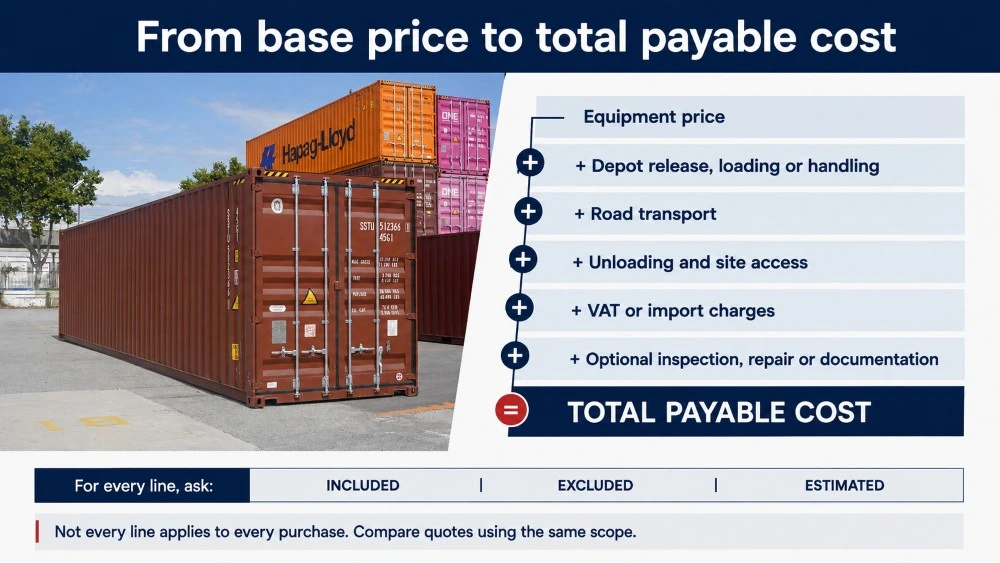
Build the total cost: Base price versus delivered or landed cost
Start by separating the container’s base price from the cost to put the equipment where it is needed. This prevents a lower initial figure from being mistaken for a lower total commitment. In a purchase quote, the working total can be assessed as follows:
Total payable cost = equipment price + quoted depot release, loading or handling + road transport + unloading and site-access services + applicable taxes or import charges + optional inspection, repair or documentation items.
Not every line applies to every purchase, and suppliers may group charges differently. Ask which items are included, excluded or estimated. In particular, “landed cost” should be defined in the quote rather than assumed to mean the same thing across transactions. Depending on the route and commercial terms, it may or may not include VAT, customs declarations, import VAT, duties, port-related costs, delivery or discharge. A supplier’s written scope is the reference point for approval.
For a collection purchase, confirm the collection terms, depot handling and who arranges onward transport. For a delivered purchase, check the named destination, the proposed delivery method and whether the recipient must provide unloading equipment or personnel. These details make the difference between a container price and a usable delivered-cost comparison.
The variables that move a European container quote
Equipment type and size
20 ft, 40 ft and 40 ft high-cube units are common ISO Series 1 freight-container categories. ISO 668 provides a framework for their classification, external dimensions and ratings, but it does not determine a commercial price or a universal price difference between sizes.
Define the equipment needed for the job before seeking quotations. Reefers, tanks, open tops and flat racks are specialised equipment and should be quoted separately against the exact operating requirement.
Condition and suitability for the intended use
Condition is not a single universal grade. Ask the seller to describe the unit clearly, including its structural and weather-resistance condition where relevant, visible repairs, doors, flooring and any inspection evidence available.
If the container will be used in international transport, state that requirement at the start of the enquiry. The International Convention for Safe Containers (CSC) addresses safety approval, testing, inspection and maintenance for containers used in international transport; it should not be assumed to be a requirement for every static-storage purchase.
Depot, supply and destination route
A container available near one depot may not have the same price or delivery feasibility at another. Local availability, repositioning needs and the distance to the delivery point all affect a quote. Route restrictions also matter.
Road freight weights, dimensions and abnormal-load procedures are not uniform across European countries, so a transport proposal must be assessed against the actual route rather than a Europe-wide assumption.
Delivery method, site access and unloading
Road haulage can only be priced accurately once the carrier understands how the container will enter, manoeuvre at and be discharged at the destination. Access restrictions, vehicle positioning, delivery timing and the recipient’s unloading capability may affect the service required.
Confirm whether the supplier is arranging transport only or both transport and discharge, and identify any site constraints before accepting a delivery cost.
Tax, cross-border status and quote validity
VAT treatment depends on the country, the parties and the transaction route. A cross-border EU business acquisition is not assessed in the same way as a purchase from outside the EU, and Great Britain is not an EU Member State for goods-import processes. Quote validity also matters because equipment and transport availability can change.
Check the currency, VAT presentation, validity date, payment terms and all exclusions before approval.
Choose the specification before comparing price
A comparable buying process begins with the operational requirement, not with the cheapest displayed figure. For dry freight or commercial storage needs, establish whether a 20 ft, 40 ft or 40 ft high-cube container is suitable for the cargo, handling plan and available space. Then define whether the unit needs to be suitable for ongoing freight movement or a static operational use. This avoids comparing unlike equipment simply because the headline container price appears similar.
For specialised cargo or operating conditions, specify the equipment category and required features in the first enquiry. Reefer equipment, tanks, open tops and flat racks should not be benchmarked against a standard dry-container quotation. If documentation is needed for a planned transport use, list it in the request and ask the seller what can be provided for the identified unit.
Delivery cost in Europe: what the carrier needs to price it
Avoid blanket assumptions about container delivery cost in Europe. Give the carrier or supplier the operational information below so the road-haulage scope can be checked against the actual destination and delivery plan.
- Delivery postcode and country, including any site or booking requirements.
- Container size, type and condition required.
- Collection depot or preferred collection area, if known.
- Requested delivery date or time window.
- Road and site restrictions, including approach, turning space, vehicle positioning and access limitations.
- Who will receive and unload the container, and what unloading method is available.
- Whether the supplier is expected to arrange transport only, or transport and discharge.
- Any documentation or transport-use requirement that must be reflected in the quote.
Providing these inputs early helps identify exclusions before a purchase order is issued. It also lets procurement teams compare transport proposals on scope rather than on a single delivery line that may not include the same services.
Share the packed dimensions, weight, handling method and location with SILVERSEA Containers.
VAT, cross-border purchases and imports: What to confirm before approval
Treat VAT and customs as transaction-specific due diligence, not as a flat percentage to add to every container price. Within the EU, the VAT obligations for a business buying goods from another EU country can differ from those for a purchase involving a supplier outside the EU. The applicable treatment depends on factors such as the countries involved, the status of the buyer and seller, and the supply arrangement.
VAT rates are set by individual countries; an EU-level minimum standard rate does not establish the rate or treatment for a particular container transaction.
Where goods enter Great Britain, UK import processes may apply, including commodity classification and declarations where required. Before approval, ask the seller to identify the commercial terms and the party responsible for export, import, customs declarations, duties and import VAT where applicable. Confirm the treatment with a qualified local tax or customs adviser for the specific transaction; this article is operational guidance, not tax advice.
Buyer checklist: How to compare two container quotes
Use the same fields for each supplier. A quote that is marginally higher at base level may be clearer or more complete once delivery, tax and discharge responsibilities are aligned.
Container quote comparison checklist
| Check | What to verify |
| Seller, date and validity | Legal seller, quote issue date, expiry, currency and payment terms. |
| Exact unit requirement | Size, equipment type, stated condition and intended use. |
| Unit evidence | Container ID, photos and inspection evidence where available. |
| Depot and terms | Collection location or delivery destination, plus loading and release terms. |
| Transport and discharge | Whether road haulage, unloading, site-access services and waiting time are included or excluded. |
| Taxes and imports | VAT shown separately where relevant; responsibilities for customs, import VAT and duties clearly identified. |
| Documentation | Documents requested for the intended transport use, and what the seller can provide for the unit. |
| Exclusions | Repairs, inspections, handling, accessorial services and any other items not included in the total. |
Buy or lease? Use the decision that fits the operating need
Buying is generally the more direct route when ownership and a longer-term operational requirement are the priority. Where fleet flexibility or a defined operating period matters more, assess maritime container leasing alongside a purchase quote. For a one-way operational requirement, one-way maritime container rental may be relevant.
If exit planning is part of the procurement decision, review the scope of maritime container buyback separately. The right option depends on the equipment, route, period and commercial terms offered.
Request a current container quote
For a quote that reflects the real shipping container cost for your requirement, provide the destination, intended use, required size and type, condition and timing. SILVERSEA Containers can then scope the equipment and delivery requirement rather than implying a fixed price, stock position or all-inclusive service.
Request a current container quote.
Frequently asked questions
Prices differ because container supply, depot handling, local demand, the distance to the buyer and road-delivery feasibility differ. The same equipment specification can therefore produce different quotes at different depots or for different delivery postcodes. Compare the quoted scope, not just the equipment line.
Not necessarily. A listed price may be an equipment-only or ex-depot figure. Ask whether depot release or loading, road haulage, unloading, site-access services, VAT and any import-related items are included. A written inclusion and exclusion list is the safest basis for comparison.
Do not assume it is. Ask for VAT to be shown clearly and confirm the transaction-specific treatment with the seller. The relevant treatment can differ by country, buyer and seller status, and whether the transaction is domestic, intra-EU or involves an import route.
Tell the seller that the unit is intended for international transport and ask what documentation and current safety-approval evidence can be supplied for that identified container. CSC is relevant to containers used in international transport and concerns safety approval, testing, inspection and maintenance. It should not be treated as an automatic requirement for every container purchased for static use.