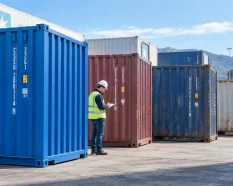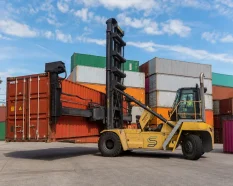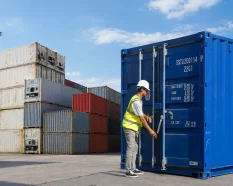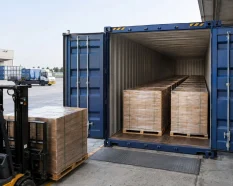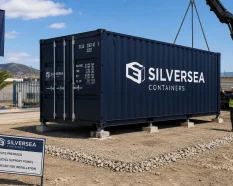














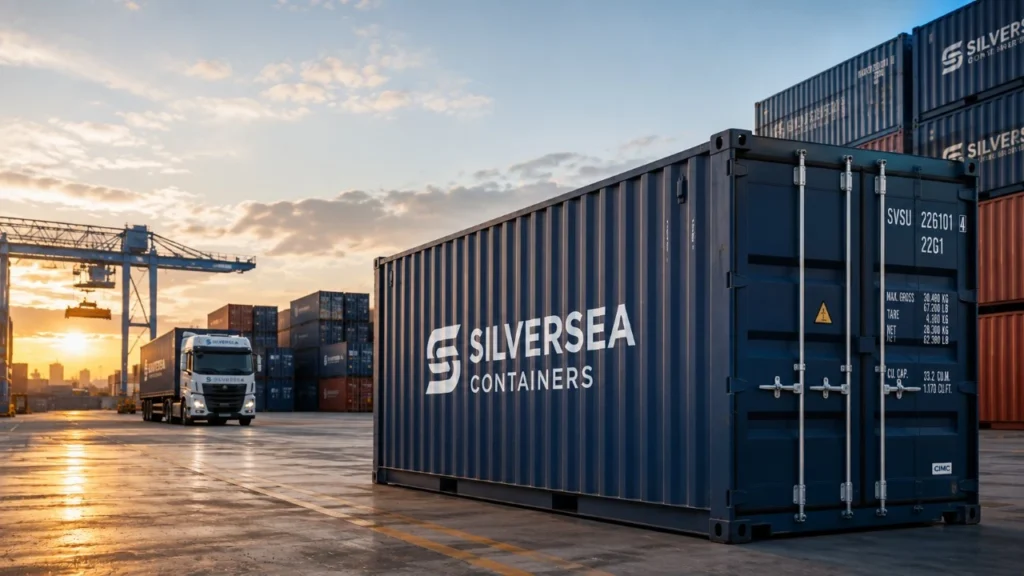
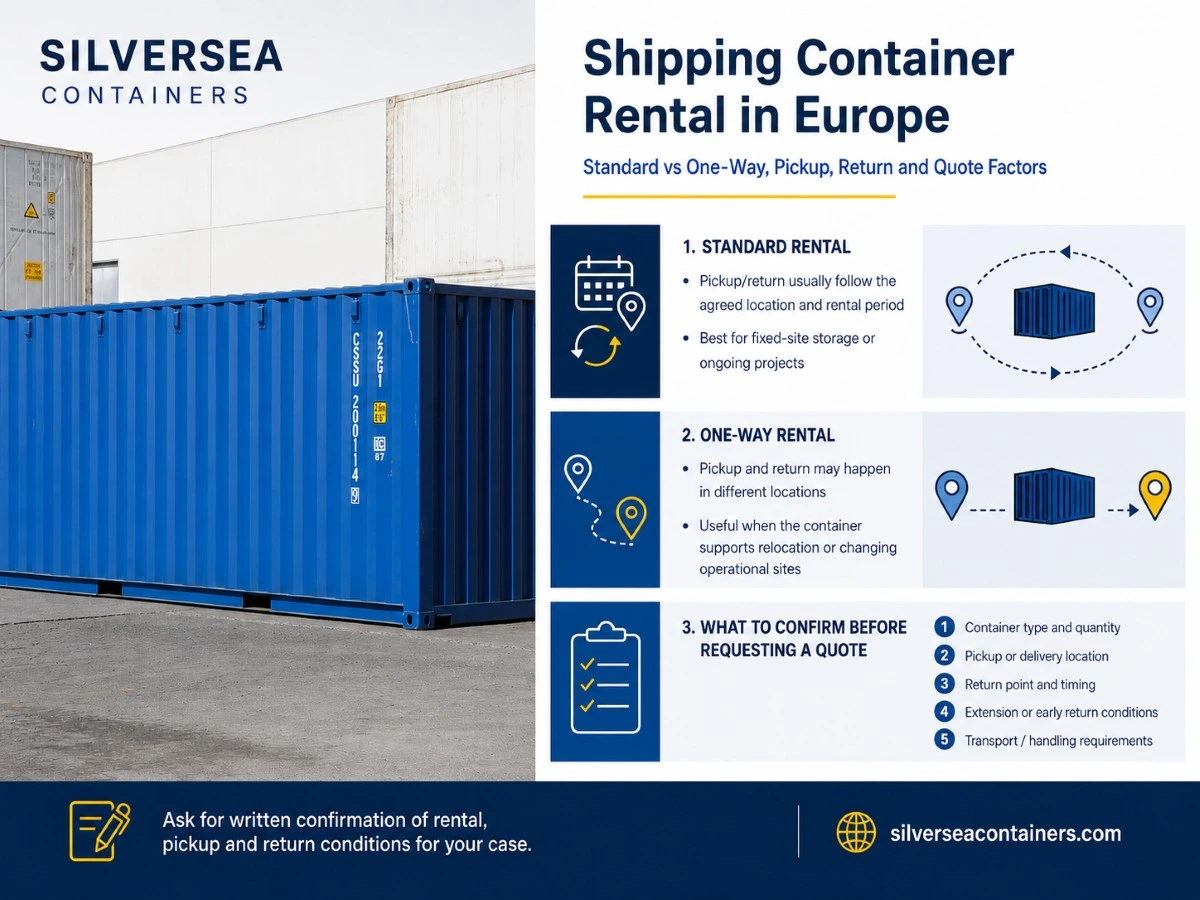
For a container that will be returned to the agreed original or assigned depot after use, a standard rental structure may be the right fit. If the equipment is collected in one location and returned to an agreed depot or city elsewhere, one-way container rental is the relevant model. In both cases, the commercial and operational fit depends on the confirmed pickup point, return point, equipment type, dates, cargo requirements and the services included in the individual quote.
This guide is designed for European freight forwarders, importers, exporters, logistics managers and project-cargo buyers arranging temporary container use. It focuses on the questions that should be resolved before requesting a quote from SILVERSEA Containers.
Standard rental vs one-way container rental at a glance
The distinction is not simply whether the container travels. Both structures can involve road, rail, barge or ocean movements, depending on the operation. The practical difference is the agreed return arrangement and how the equipment is accepted off-hire.
Neither model should be assumed to include haulage, handling, ocean freight or other services unless those items appear in the quote.
When standard container rental may be the better operational fit
Standard rental can suit a temporary requirement where the container can be returned to the agreed depot or location after use. This may be relevant when a logistics operation has a defined starting point, a known period of use and a practical return route to the same or assigned facility.
The return location should be treated as a contractual and operational detail, not an assumption. A container is not automatically returnable to the depot that is most convenient for the customer, nor is the original pickup depot necessarily the final return point. Before collection, confirm the accepted location, the planned off-hire date or window and the process for notifying the supplier that the equipment is ready.
Companies comparing broader leasing structures can review maritime container leasing for the relevant commercial route. This article, however, focuses on choosing the return model and preparing the information needed for a route-specific rental discussion.
When one-way container rental may be the better operational fit
One-way rental means collecting the container in one location and returning it to an agreed different depot or city. It can be useful when the equipment needs to move toward a destination where an accepted return point is available, rather than travelling back to the original location.
The key point is that one-way does not mean “return anywhere.” The destination depot or facility must be confirmed for the specific equipment, route and dates. Acceptance may depend on the equipment type, the intended use, the destination network and the supplier’s current operational arrangements. Transport to the return point may also be quoted separately or treated as part of a defined service scope; this must be confirmed rather than inferred.
If the collection and return locations are already known, use one-way maritime container rental to review the relevant service context, then provide the route details required for a commercial assessment.
Pickup in Europe: what to confirm before collection
A smooth pickup starts with a precise release arrangement. “Europe” is too broad to serve as a pickup instruction: the supplier needs the relevant city, depot, terminal or other agreed location and the date on which the equipment is required.
- The exact pickup city, depot, terminal or agreed release location.
- The equipment type, size, quantity and condition required for the intended use.
- The collection date and, where applicable, the preferred collection window or appointment.
- The collecting party, haulier or other nominated transport provider.
- Release references, identification details or collection instructions required by the agreed facility.
- Whether onward transport, loading, handling or other services are included, separately arranged or excluded from the rental quote.
- Any cargo, route or operating requirements that could affect equipment suitability.
- The commercial entity, billing details and contact responsible for the booking.
The party collecting the container should also understand who is responsible for the road leg and for checking the equipment at collection. Responsibilities vary by agreement. A quote should therefore distinguish the rental of the container from the movement, handling and operational services surrounding it.
Return and off-hire: avoid assumptions
The return stage is where many avoidable misunderstandings arise. Before the container is collected, confirm the agreed return depot, the required return date or window and whether an appointment or prior notification is needed. For a one-way arrangement, confirm that the destination facility has accepted the proposed equipment and route.
The agreement should also define the expected condition at return. Depending on the transaction, this may include requirements concerning emptying, cleaning, inspection or reporting of damage. Do not assume that every supplier or depot applies the same procedure. Ask how the container should be presented for off-hire and which event formally ends the rental.
Terms such as free days, detention, demurrage, damage charges or return fees should never be inferred from a general article. If relevant to the proposed operation, request the applicable commercial terms in writing for the equipment, route and dates concerned.
What affects a container rental quote in Europe?
A useful rental quote is route-specific. For a shipping container rental Europe enquiry, the supplier needs enough information to assess equipment allocation, return acceptance and the scope of services.
The following checklist covers the core inputs for a shipping container rental quote in Europe.
- Pickup city, depot, terminal or agreed release point.
- Return city and depot, or confirmation that the container will return under a standard arrangement.
- Equipment type and size, such as the required freight-container format, together with the quantity.
- On-hire date and planned off-hire date or rental duration.
- Cargo or intended freight use, including any special handling or equipment requirements.
- Condition, safety approval or other documentation requirements relevant to the proposed international transport operation.
- Transport and handling scope: identify whether road haulage, rail, barge, port handling, loading or other services are required.
- Business and invoicing details, including the contracting entity and relevant operational contact.
Origin, destination, duration and return arrangement are the essential route variables. A request that includes only “shipping containers for rent in Europe” may start the conversation, but it is unlikely to support a meaningful quote until the locations, dates and equipment requirements are specified.
Equipment and cargo suitability: Questions to resolve before booking
Container suitability has two related but different dimensions. First, the equipment must be appropriate for the intended transport operation and in the required technical condition. Second, the cargo must be packed, secured and transported in a way that is appropriate for its characteristics and route.
For international transport, ask whether the proposed equipment has the safety approval and documentation required for the operation. The International Convention for Safe Containers (CSC) provides a framework for the safety approval, testing, inspection and maintenance of freight containers used in international transport. A CSC safety approval plate contains relevant technical data, but the applicable documentation and acceptance should be confirmed for the specific movement.
The CTU Code is a non-mandatory international code of practice covering the handling and packing of cargo transport units for sea and land transport. It can help teams review packing and securing responsibilities, but it should not be presented as a universal legal requirement. Local rules, carrier requirements and cargo-specific obligations may also apply.
Before booking, clarify the cargo dimensions, mass, loading method, securing needs, sensitivity to weather or contamination and any special operating constraints. These details help determine whether the requested equipment and proposed route are suitable.
Europe-specific scope: Cross-border operations need route-specific confirmation
Europe is a regional commercial market, not one uniform operational or legal zone. A rental involving one country may differ materially from a cross-border movement involving several countries, terminals or transport modes. Depot access, road legs, customs status, invoicing, VAT treatment and carrier arrangements can depend on the countries and parties involved.
Containers can form part of an intermodal movement involving road, rail, barge or ship. The European Commission describes combined transport as the use of more than one transport mode, often with road legs at the beginning or end of the journey. That context does not establish a particular service, route or regulatory treatment for an individual rental.
For that reason, avoid treating a general regional statement as confirmation of coverage or acceptance. Provide the full route and ask the commercial team to confirm applicable operational, documentation and invoicing requirements. This is especially important when the rental and the transport service are supplied under separate scopes.
Request a container rental quote
Prepare the following information before contacting SILVERSEA Containers:
- Pickup location and preferred collection date.
- Return location, depot or destination city.
- Standard-return or one-way requirement.
- Container type, size and quantity.
- Planned on-hire and off-hire dates.
- Cargo or intended use and any special requirements.
- Required transport, handling or delivery scope.
- Company, invoicing and operational contact details.
The more precise the route and equipment information, the easier it is to assess the operational fit and define what the quote covers. For a route-specific request, request a container rental quote.
Frequently asked questions
No. One-way rental is a temporary-use arrangement in which collection and return locations are agreed for the transaction. Buying transfers ownership under a separate commercial model. This article does not compare purchase prices or ownership economics.
Not automatically. The return depot or facility must be agreed in advance, particularly for one-way rental. Acceptance can depend on the route, equipment, timing and the facility’s operational arrangements.
Not necessarily. Container rental, road haulage, ocean freight, rail or barge transport, port handling and other services may be treated separately. The individual quote should identify what is included, excluded or arranged by the customer.
Provide the pickup and return locations, equipment type and quantity, on-hire and planned off-hire dates, cargo or intended use, relevant technical or transport requirements, the desired service scope and business invoicing details. These inputs allow the route and return model to be assessed together.
Conclusion: Choose the return model first
The simplest decision rule is operational: if the container can return to the agreed original or assigned location, standard rental may be appropriate; if it needs to be collected in one place and returned to an agreed different depot or city, one-way rental should be evaluated. In both cases, availability, depot acceptance, equipment suitability, dates and included services require confirmation for the specific route.
Once those details are ready, SILVERSEA Containers can assess the request more effectively and clarify the commercial scope. Request a container rental quote with the pickup, return, equipment and timing information that applies to your operation.