













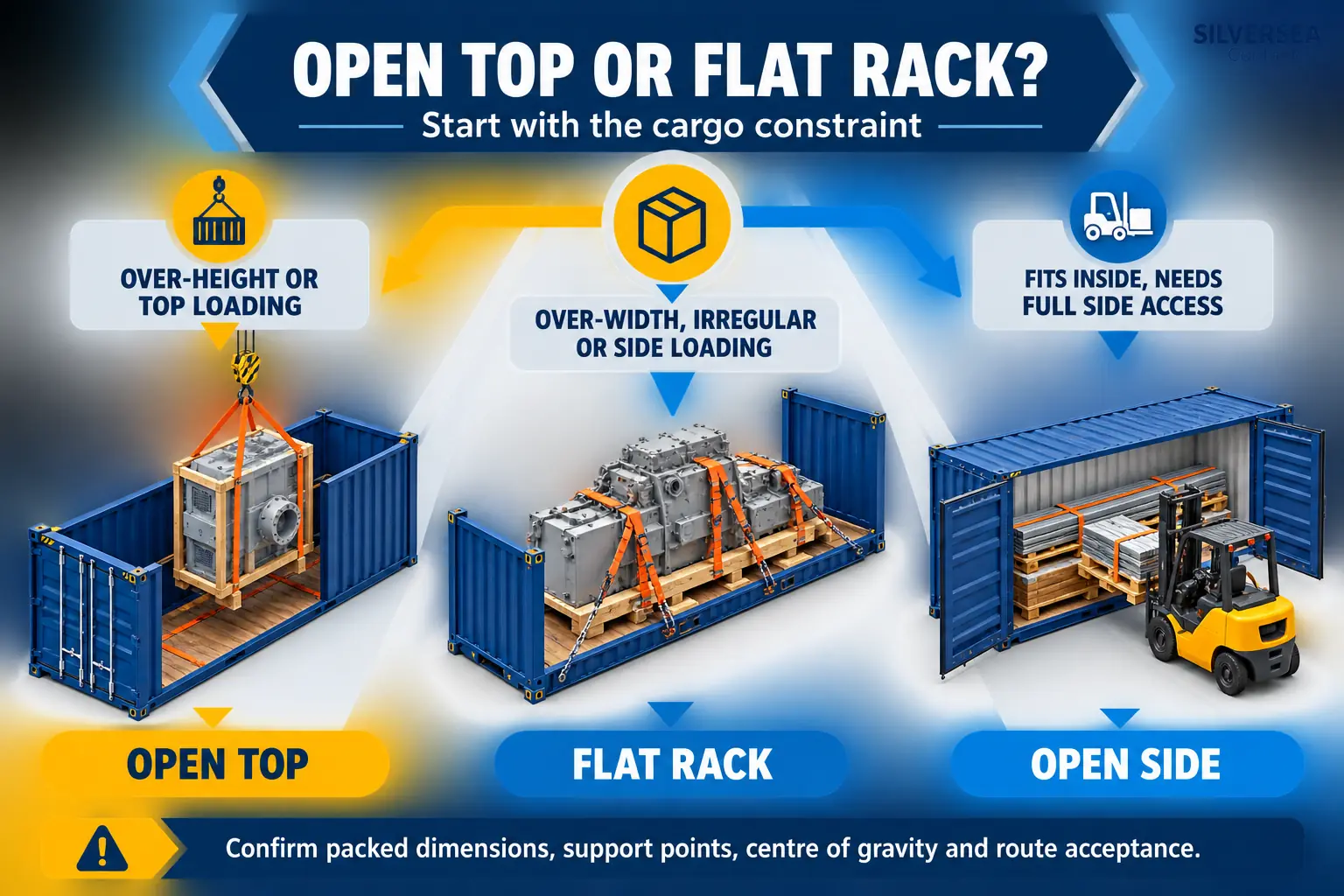
Open top and flat rack containers are both used when a standard dry container cannot handle the cargo. But they solve different problems. An open top is usually the first option when the cargo needs overhead loading or controlled over-height while remaining within the side walls. A flat rack is generally better when width, length, side access, exposed geometry or the support footprint becomes the main constraint.
The decision should never be based on the cargo label alone. “Heavy machinery”, “industrial equipment” and “oversized cargo” describe broad categories, not an equipment specification. The correct choice depends on the cargo after packing, how it will be lifted, how its mass is distributed, how it must be secured and whether the complete movement is acceptable on the planned route.
The quick answer: Open Top or Flat Rack?
Choose an Open Top when the main restriction is access from above or cargo height, the load can remain between the side walls and the box structure provides useful containment and protection.
Choose a Flat Rack when the cargo is too wide, too long or too awkward for side walls; when loading must take place from the side; or when the support and securing arrangement is better suited to an open platform with end walls.
Consider an Open Side or full-side-access container when the cargo fits within an enclosed container profile but cannot be handled efficiently through the end doors. This is mainly an access solution, not a substitute for a Flat Rack in a genuine over-width movement.
| Decision factor | Open Top | Flat Rack |
|---|---|---|
| Basic structure | Rigid side walls and end doors; removable roof bows and cover, depending on the unit | Reinforced base with fixed or collapsible end walls; no roof or side walls |
| Loading access | Primarily from above, with end-door access also available | From above, the sides or the ends, subject to the loading arrangement |
| Best starting point | Cargo that is over-height, difficult to pass through the doors or easier to lower into place | Cargo that is over-width, over-length, irregular, exposed or requires unrestricted side access |
| Side containment | Yes | No |
| Weather protection | More protection than a Flat Rack, but not equivalent to a closed dry container | No inherent roof or side protection; packaging must address exposure |
| Securing implication | Side walls do not replace a securing plan; access can become limited after loading | More open access for securing, but the cargo is fully exposed and may need a more engineered arrangement |
| Main limitation | The cargo and lifting path still have to work within the side-wall and end-frame geometry | Route, handling, stowage, protection and OOG approvals can become more complex |
Why a standard dry container may no longer work
A standard container can have enough nominal volume and still be unsuitable. The cargo may not pass through the door aperture, the lifting equipment may not have a safe approach, or a wide support frame may prevent the unit from being positioned correctly.
A concentrated load can also create a different problem from total payload: the container may be rated for the overall mass but not for the way that mass is applied to a small area of the floor.
Start by identifying the actual limiting condition:
• The packed cargo is taller than the door opening or needs to be lowered by crane.
• The packed cargo exceeds the usable internal width or length.
• The load fits dimensionally but cannot be manoeuvred through the end doors.
• The support frame, cradle or contact points create concentrated loads.
• The centre of gravity or lifting arrangement requires better access for positioning and securing.
• The cargo needs more protection than an exposed platform can provide.
This constraint-led approach is more reliable than starting with a product name and trying to make the cargo fit it.
When an Open Top is usually the better choice
An Open Top retains the basic box structure of a general-purpose container but replaces the fixed roof with removable components and a cover. That makes it useful when vertical access is the decisive issue.
Typical candidates include tall machinery, industrial components, tanks, coils or crated equipment that can fit between the side walls but cannot be loaded safely through the end doors. The cargo can be lowered into position from above, after which it must be supported and secured for the planned movement.
An Open Top is often the more controlled option when:
• The cargo is mainly over-height rather than over-width.
• A crane or overhead lifting system is available at origin and destination.
• The load benefits from rigid side walls and a more enclosed structure.
• The packed footprint and support arrangement fit the exact unit.
• The lifting path clears the door header, top rails, bows and corner posts as applicable.
For a deeper operational guide, see SILVERSEA Containers’ article on shipping industrial equipment in an Open Top container. The comparison here is limited to selecting the equipment path.
What an Open Top does not solve
An Open Top is not automatically suitable simply because the cargo is tall or heavy. The load must still work with the side-wall spacing, the structural limits of the exact unit and the planned handling method. If cargo protrudes above the normal top profile, the cover may not be usable in its standard arrangement and the movement may be treated as out of gauge.
Do not assume that the tarpaulin provides the same protection as a closed steel roof. Moisture-sensitive equipment may require additional wrapping, crating or corrosion protection based on the route and exposure period.
When a Flat Rack is usually the better choice
A Flat Rack removes the side walls and roof while retaining a reinforced base and end structures. The open geometry makes it the stronger candidate when the problem is width, length, unrestricted side access or an irregular load shape.
Flat Racks are commonly evaluated for machinery, vehicles, fabricated structures, long steel components, large skids and other cargo that cannot be contained by an Open Top’s side walls. They also provide wider access for positioning supports, cradles and securing equipment.
A Flat Rack is often the better starting point when:
• The cargo or its cradle is over-width.
• The load protrudes beyond the normal length or requires open-end handling.
• Side loading is essential at origin or destination.
• The cargo has an irregular profile that cannot be lowered safely between Open Top side walls.
• The support pattern and securing design require unobstructed access around the load.
Review the available flat rack and special container options before using generic dimensions or payload values in a transport plan. The exact unit specification must be confirmed.
What a Flat Rack does not solve
A Flat Rack does not make an oversized movement automatically feasible. Cargo remains exposed, and any lateral or vertical projection affects handling, stowage and the total transport envelope. A load may fit on the platform but still be unsuitable for the road route, terminal equipment, vessel plan or destination handling arrangement.
Weight alone is also not enough to select a Flat Rack. Gross mass, concentrated loads, support footprint, centre of gravity and securing forces must be considered against the technical limits of the exact equipment and the movement as a whole.
Six checks that should decide the equipment
1. Measure the cargo after packing
Use the final transport dimensions, including crates, skids, cradles, protective covers and lifting frames. A drawing of the machine without its transport packaging is not sufficient. Record length, width and height, including every projection.
2. Confirm mass, support and centre of gravity
Provide the gross cargo mass and identify where it is applied. A compact machine on four small feet behaves differently from a longer skid spreading the same mass across a larger area. Mark the centre of gravity, support points and any requirement for dunnage or a custom cradle.
3. Plan loading and unloading at both ends
The origin may have an overhead crane while the destination has only a mobile crane or forklift. Equipment that can be loaded into an Open Top at origin may become difficult to remove at destination. Confirm lifting capacity, reach, access, headroom and the sequence for removing securing materials.
4. Decide how much protection the cargo needs
Open Top side walls provide more containment and the removable cover can provide a degree of overhead protection when it can be fitted correctly. A Flat Rack offers no built-in side or roof protection. Sensitive cargo may require export packing, wrapping, desiccants, corrosion control or a weatherproof crate regardless of the selected equipment.
5. Treat securing as part of equipment selection
The best container is not just the one the cargo fits onto. It is the one in which the cargo can be supported, blocked and secured for the forces expected during road, rail and sea movement. Confirm that rated securing points are accessible and that the proposed arrangement does not rely on the container walls as an unverified restraint system.
6. Check the complete route and transport envelope
For UK and European movements, an abnormal load may require route assessment, notifications, permits or escorts. Requirements vary by jurisdiction. The relevant measurement is usually the complete laden vehicle and cargo combination, not the container in isolation. Road clearances, bridges, turning space, terminal lifting equipment and vessel stowage can all affect the final decision.
Decision examples for industrial cargo
| Cargo situation | First option to assess | Reason |
|---|---|---|
| Tall crated machine that fits between the side walls | Open Top | Overhead loading solves the main access problem while retaining side containment |
| Wide skid or machine base | Flat Rack | The absent side walls allow an over-width footprint, subject to approval |
| Long fabricated structure | Flat Rack | Open geometry provides better access for support and securing |
| Heavy compact unit that cannot pass through end doors | Open Top or Flat Rack | Weight alone does not decide; compare support, access, protection and route constraints |
| Long pallets or materials that fit inside the container profile | Open Side | The main issue is lateral access rather than OOG geometry |
| Cargo beyond the safe or approved limits of both options | Project-cargo assessment | A platform, breakbulk or another transport method may be required |
Where an Open Side container fits
Open Side equipment, also described in some markets as full-side-access equipment, provides access along one long side. It can be useful for long materials, palletised cargo, event equipment or machinery that fits within an enclosed container but is awkward to handle through the rear doors.
Its role is different from a Flat Rack. If the side doors must close for the planned transport, the cargo still has to fit within the unit’s usable internal profile. An Open Side therefore improves handling access; it does not normally solve a true over-width requirement.
Configuration, door layout, ratings and acceptance can vary. Confirm the exact equipment and whether it is suitable for storage, inland movement or international maritime transport before treating Open Side as the final answer.
Common mistakes that create rework or delay
• Selecting by cargo name instead of final packed dimensions.
• Assuming every heavy machine needs a Flat Rack.
• Using a manufacturer’s net weight instead of the transport-ready gross mass.
• Ignoring concentrated floor loads and support spacing.
• Checking the loading crane but not the unloading equipment.
• Treating an Open Top cover as equivalent to a closed dry-container roof.
• Providing approximate OOG projections rather than measured dimensions.
• Confirming the container but not the road, terminal and destination route.
• Assuming that a unit available in one location will be available or accepted for another movement.
Information to prepare before requesting a quote
A useful quotation starts with transport-ready information. Provide:
• Packed length, width and height, including every projection.
• Gross cargo mass, including packaging, skid or cradle.
• Technical drawing and recent photographs.
• Centre of gravity and lifting points.
• Support footprint, point loads and proposed dunnage.
• Required loading and unloading method.
• Origin, destination, preferred date and expected route or transport mode.
• Required protection against weather, moisture, impact or corrosion.
• Whether the unit will enter international maritime transport.
• Any dangerous-goods, battery, liquid or contamination considerations relevant to acceptance.
With these inputs, the discussion can move from a generic product request to a realistic equipment assessment.
How SILVERSEA Containers can support the decision
SILVERSEA Containers can assess purchase, leasing and container-supply requirements based on the requested location, equipment type, quantity, dates and intended use. For special equipment, suitability and availability remain subject to the exact unit specification and operating plan.
Businesses evaluating ownership can review the buy maritime containers service. If the requirement is already defined, request a tailored container quote and include the packed dimensions, mass, support, handling and route information listed above.
If the equipment will enter maritime transport or differs from a standard freight-container configuration, review the distinction between ISO and non-ISO containers before assuming that physical fit alone confirms transport compatibility.
Share the packed dimensions, weight, handling method and location with SILVERSEA Containers.
Frequently asked questions
An Open Top has rigid side walls and removable roof components, making it useful for top-loaded or over-height cargo that fits within the side-wall geometry. A Flat Rack has no roof or side walls, making it more suitable for over-width, over-length, irregular or side-loaded cargo.
No. Weight is only one factor. If the machinery fits between the side walls and mainly requires overhead loading, an Open Top may provide a more contained solution. The final choice depends on the exact mass distribution, support, access, securing and route.
It may be possible, but the cargo becomes an out-of-gauge movement and requires confirmation for the exact dimensions, equipment and route. The standard cover arrangement may no longer be usable, so cargo protection must also be reviewed.
An Open Side can be useful when the cargo fits within the enclosed profile but needs lateral forklift access, easier pallet handling or repeated side access. It is not normally the answer when the cargo itself is wider than the container profile.
Final packed dimensions produce the most useful quotation. Early estimates can support an initial discussion, but equipment selection and transport planning should not be confirmed from approximate machine dimensions alone.
No. The road movement, handling facilities, terminal acceptance and ocean-leg stowage may impose additional constraints. Confirm the complete laden transport envelope and the approvals applicable to the actual route.