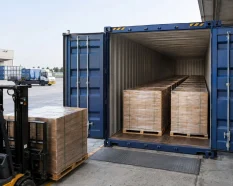














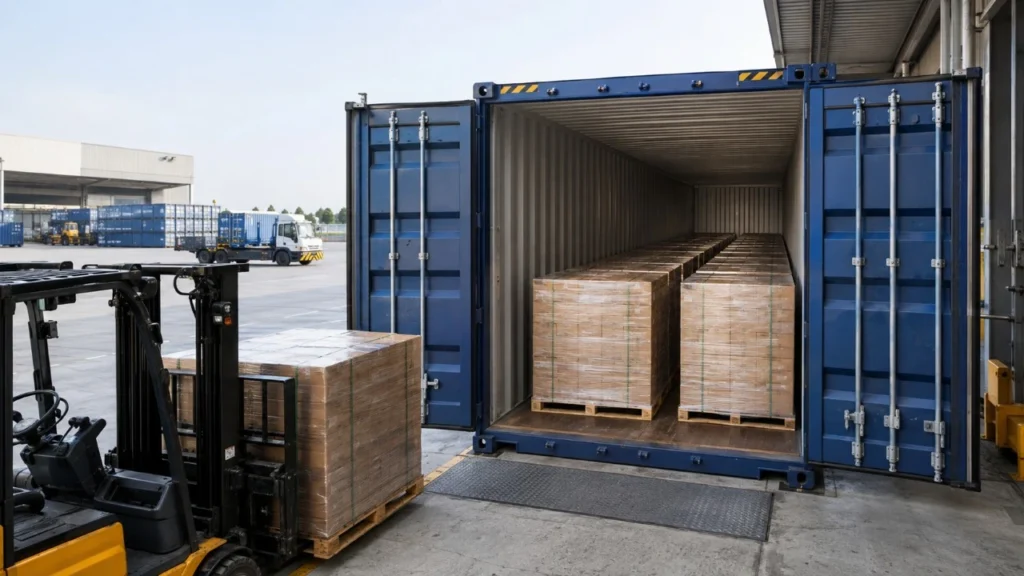
A Pallet Wide container is designed to use the footprint of Euro pallets more efficiently than a conventional dry container. In a typical 40ft comparison, a standard container accommodates up to 25 Euro pallets in a single layer, while a suitable 40ft Pallet Wide unit can accommodate 30.
That represents 20% more pallet positions within the same nominal container length. However, it does not automatically mean 20% more cargo by weight or 20% lower freight costs. Payload, pallet height, cargo overhang, equipment specifications and route acceptance still determine the real result.
For exporters, retailers, manufacturers and freight forwarders moving palletized cargo into or across Europe, the decision should therefore be based on more than nominal container size. The relevant question is:
How much does it cost to move each usable pallet position safely from origin to destination?
The geometry problem of the Euro pallet
The EPAL Euro pallet, also known as EPAL 1, has a standardized footprint of 800 × 1,200 mm. These dimensions are confirmed by the European Pallet Association.
The critical calculation is simple:
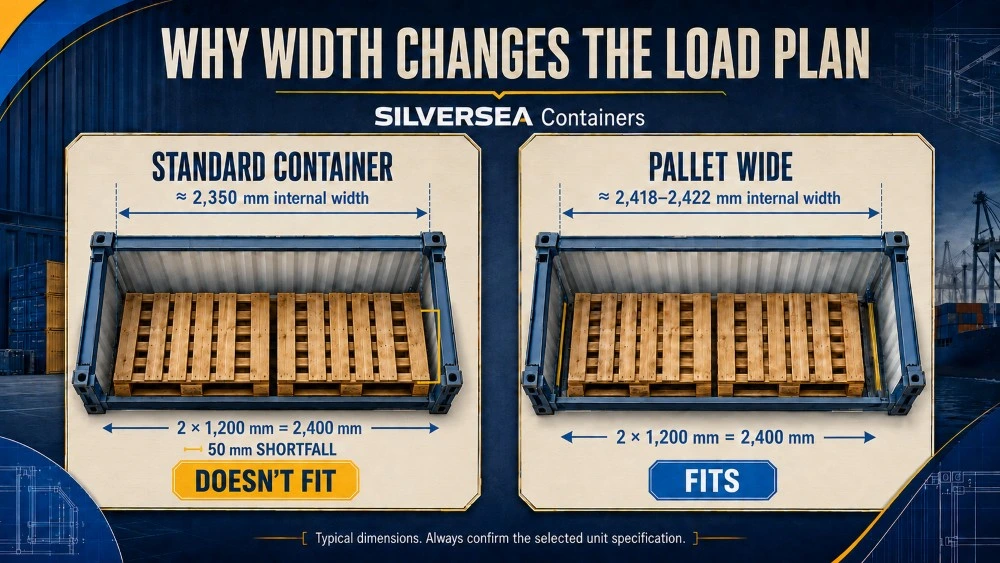
1,200 mm + 1,200 mm = 2,400 mm
If two Euro pallets are positioned with their 1,200 mm sides across the container, the available floor width must exceed 2.40 metres—and must also provide enough tolerance for pallet condition, cargo overhang and handling.
A conventional dry container normally provides approximately 2.35 metres of internal width. For example, Hapag-Lloyd lists 2,350 mm for one of its 40ft High Cube specifications, while also warning that measurements can vary by manufacturer.
This means that two 1,200 mm pallet sides cannot be placed directly across that floor:
Required width: 2,400 mm
Typical standard internal width: 2,350 mm
Nominal shortfall: 50 mm
A standard container can still carry Euro pallets. Operators obtain the familiar capacities of approximately 11 pallets in a 20ft unit and 25 in a 40ft unit by using mixed orientations across the floor. The difference is that the layout cannot be built from simple, repeatable rows designed around the Euro pallet footprint.
For a broader comparison of pallet formats and standard container sizes, see SILVERSEA Containers’ guide to shipping container pallet capacity.
Internal dimensions: Standard vs Pallet Wide containers
A Pallet Wide container gains usable floor width through its wall and frame design. Depending on the model, its internal width may be approximately 2.42 to 2.44 metres, allowing 2.40 metres of pallet footprint to be used across the floor.
However, “Pallet Wide” describes a family of equipment rather than one universal specification.
| Specification | Standard dry or High Cube | Pallet Wide |
| Typical internal width | Approximately 2.35 m | Approximately 2.42–2.44 m |
| Width needed for two 1,200 mm pallet sides | 2.40 m | 2.40 m |
| Straight two-pallet fit across width | No | Usually yes |
| Typical 40ft Euro pallet capacity | Up to 25 | Up to 30 |
| External width | Usually 2.438 m | May be approximately 2.462, 2.50 or 2.55 m |
| Door opening | Model-dependent | Model-dependent and potentially narrower than the interior |
The variation in external width is important. Some cellular Pallet Wide designs are engineered for handling within conventional intermodal systems. Other European 40ft and 45ft units have a wider external body and route-specific features.
A buyer or lessee should never assume that every Pallet Wide container is operationally interchangeable with a standard ISO unit. The equipment data sheet, CSC plate, corner-fitting configuration, carrier acceptance and road or rail restrictions must all be checked.
SILVERSEA Containers’ guide to ISO vs non-ISO containers provides additional context for this distinction.
Pallet Wide is not the same as High Cube
These terms describe different characteristics:
- Pallet Wide refers primarily to additional usable width for palletized cargo.
- High Cube refers to additional height, normally increasing the container’s external height from 8ft 6in to 9ft 6in.
A container can be Pallet Wide, High Cube or both. High Cube height can help with tall pallet loads or double-stacking where the cargo permits it, but it does not automatically increase the number of pallet positions available on the floor.
Euro pallet capacity comparison
The following figures describe typical single-layer loading capacities. Actual capacity must be confirmed against the selected unit and cargo.
| Container type | Typical Euro pallet positions | Difference |
| 20ft standard dry container | 11 | Baseline |
| 20ft High Cube Pallet Wide | 14 | 3 additional positions, or approximately 27% |
| 40ft standard or High Cube container | 25 | Baseline |
| 40ft High Cube Pallet Wide | 30 | 5 additional positions, or 20% |
| 45ft High Cube Pallet Wide | 33 | High-capacity European configuration |
These are pallet-position increases, not guaranteed cargo-weight increases. The maximum payload and permitted weight distribution may be reached before every position can be used, particularly with dense products.
Published equipment specifications illustrate the variation:
- Seaco lists 14 Euro pallets for one 20ft High Cube Cellular Palletwide model.
- The same operator lists 30 Euro pallets for its 40ft High Cube Cellular Palletwide.
- European 45ft Pallet Wide equipment is commonly specified for 33 Euro pallets by operators such as Samskip and manufacturers such as UNIT45.
Some 20ft Pallet Wide designs advertise 15 positions rather than 14. That is why the exact model data sheet should take precedence over a generic capacity chart.
What the loading plans look like?
The additional positions are easier to understand when the floor plans are described in pallet rows.
20ft standard container: up to 11 Euro pallets
The pallets use a mixed-orientation arrangement. Some are placed with the 1,200 mm side running across the floor and others are rotated to use the remaining length and width.
This arrangement works, but it is less regular than a Pallet Wide loading plan.
20ft Pallet Wide container: typically 14 Euro pallets
A common verified configuration uses:
- Two pallets across the width
- Seven rows along the container
- Fourteen pallet positions in total
The two 1,200 mm sides use 2,400 mm of internal width, while the seven 800 mm dimensions use 5,600 mm of internal length.
40ft standard container: up to 25 Euro pallets
The standard 40ft configuration also relies on alternating pallet orientations. It can provide 25 positions, but it cannot produce 15 straight rows of two Euro pallets because the necessary 2,400 mm internal width is unavailable.
40ft Pallet Wide container: up to 30 Euro pallets
Depending on the unit and loading method, the floor can be planned as:
- Two pallets across and fifteen rows along the container; or
- Three 800 mm sides across and ten 1,200 mm rows along the container.
Both patterns produce 30 pallet positions.
45ft Pallet Wide container: typically 33 Euro pallets
A common floor plan uses three pallets across and eleven rows along the unit, producing 33 positions.
These are geometric loading plans, not cargo-securing instructions. Pallets and their loads may have dimensional tolerances or overhang, and cargo must still be packed and secured according to the shipment characteristics. The IMO/ILO/UNECE CTU Code remains the relevant international reference for safe packing and securing practices.
How to calculate freight cost per pallet?
Comparing only the container quotation can produce the wrong decision.
The more useful B2B metric is:
Cost per pallet = total shipment cost ÷ usable loaded pallet positions
Suppose the total door-to-door cost of moving a standard 40ft container is €3,000:
€3,000 ÷ 25 pallets = €120 per pallet
If a 40ft Pallet Wide container can be moved on the same route for the same total cost:
€3,000 ÷ 30 pallets = €100 per pallet
The cost per pallet would be approximately 16.7% lower.
The Pallet Wide quotation does not need to be identical to remain competitive.
If its total cost were €3,300:
€3,300 ÷ 30 pallets = €110 per pallet
It would still cost €10 less per pallet than the standard option.
The 40ft break-even calculation
For a comparison between 25 and 30 pallet positions:
- Maximum Pallet Wide cost at break-even = standard cost × 30 ÷ 25
That equals:
Standard cost × 1.20
In other words, the total Pallet Wide movement could cost up to 20% more than the standard movement before the two options reach the same theoretical cost per pallet.
This calculation is only valid when all pallet positions can actually be used. The evaluation must also consider:
- Loaded weight per pallet
- Container payload
- Cargo overhang
- Weight distribution
- Door clearance
- Loading and unloading costs
- Equipment positioning or repositioning
- Carrier and terminal charges
- Empty-return requirements
- Damage and securing risks
When does a Pallet Wide container make commercial sense?
Pallet Wide equipment is particularly relevant when:
- A high percentage of the cargo moves on 800 × 1,200 mm Euro pallets.
- Shipments regularly fill the available floor before reaching the payload limit.
- The business moves repeat volumes on stable routes.
- Additional pallet positions can reduce the annual number of container movements.
- Loading plans can be standardized across factories, warehouses or distribution centres.
- The savings per pallet exceed any equipment, repositioning or route premium.
For businesses in the United States, Canada or other markets where the 48 × 40-inch GMA pallet is more common, Pallet Wide equipment may still be useful when the cargo is prepared specifically for European distribution. It should not be selected merely because it offers more internal width.
A standard container may remain the better choice when the cargo is very heavy, non-palletized, irregularly shaped, available equipment is limited or the Pallet Wide unit creates additional route or positioning costs.
Availability, procurement and route acceptance
Pallet Wide containers are specialized equipment. Availability can vary by size, condition, depot, country and transport corridor.
There are two main procurement routes:
Carrier-owned equipment
A carrier or multimodal operator may provide Pallet Wide equipment on selected services. This can simplify operational coordination, but availability should be confirmed for the required origin, destination and date.
Shipper-owned or leased containers
Buying or leasing the equipment can provide greater control over specification and fleet availability. However, using a shipper-owned container does not remove the need for carrier acceptance.
Before purchasing or leasing, verify:
- Exact internal and external dimensions
- Door-opening width and height
- Tare, maximum gross weight and payload
- CSC status and inspection validity
- Corner-fitting and handling configuration
- Acceptance by the ocean carrier, terminal, rail operator and haulier
- Road restrictions at origin and destination
- Depot release and empty-return conditions
- Repositioning costs
- Availability of matching units for future shipments
How to choose between standard and Pallet Wide?
The most reliable decision starts with the cargo rather than the equipment catalogue.
Send the supplier or logistics partner:
- Pallet standard and exact loaded dimensions
- Pallet weight
- Total pallets per shipment
- Stackability
- Cargo type
- Origin and destination
- Transport modes
- Required departure frequency
- Preferred container size
- Purchase, short-term lease or long-term lease requirement
From that information, the standard and Pallet Wide options can be compared using actual pallet utilization and total landed cost.
Faqs
A typical 40ft Pallet Wide container can accommodate 30 Euro pallets in a single layer, compared with up to 25 in a conventional 40ft dry container. Confirm the figure against the selected unit’s data sheet.
Not when both 1,200 mm sides are placed across a typical 2,350 mm internal width. They require 2,400 mm. Standard containers reach their usual pallet capacity through alternating orientations.
No. Published internal widths vary by model, with common examples ranging from approximately 2.418 to 2.44 metres. External width and door opening also vary.
Not automatically. Some designs are suitable for conventional cellular and intermodal handling, while others have wider external dimensions or route-specific configurations. Carrier, terminal and inland-transport acceptance must be confirmed.
No. It reduces the theoretical cost per pallet only when the additional positions can be used and the equipment, positioning and transport premium does not cancel the capacity advantage.
Optimize your next palletized shipment
A Pallet Wide container can provide a measurable advantage for repeat Euro-pallet flows—but only when the equipment specification, cargo weight and transport route align.
SILVERSEA Containers can help you compare sourcing or leasing alternatives according to your pallet dimensions, shipment volume, required location and operational period.
Request a tailored container quote and include your pallet count, loaded dimensions, weight, route and preferred container size. This allows the team to evaluate real capacity and availability rather than relying on nominal figures alone.