













f your cargo only needs protection from rapid temperature changes, an insulated container may be enough. If it must remain within a defined temperature range over time, you normally need an operating reefer together with suitable power, loading and monitoring arrangements.
That is the short answer. The commercial decision is more detailed because “insulated container” can describe different equipment, reefer specifications vary, and the container is only one part of a temperature-control process. Before asking for a price, define the required outcome: passive thermal buffering or active temperature management.
This guide is for UK and European procurement teams, logistics managers and industrial operators comparing equipment for transport, temporary storage or project use. It does not replace a cargo-specific cold-chain assessment, qualification process or applicable regulatory advice.
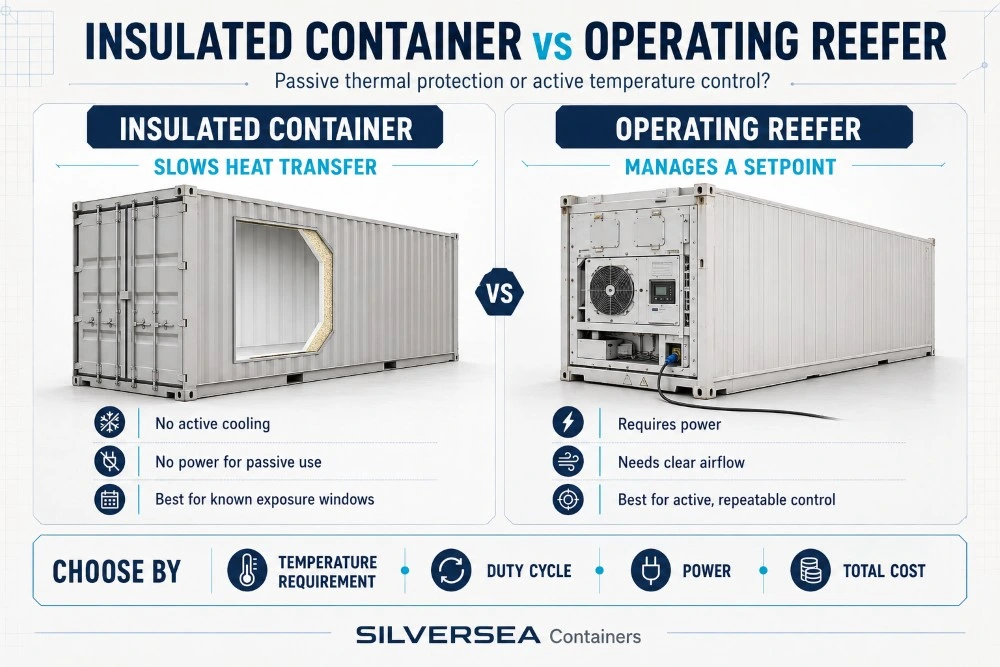
Insulated Container vs Reefer: The difference in one table
| Requirement | Insulated container | Operating reefer |
|---|---|---|
| Primary function | Slows heat transfer between the interior and ambient environment | Actively manages the internal temperature using an integrated refrigeration unit |
| Power | Normally not required for the passive container itself | Required while the refrigeration unit is operating |
| Temperature setpoint | No active correction of temperature drift | A setpoint can be configured within the verified capability of the specific unit |
| Response to warm cargo | Cannot remove significant product heat by itself | Designed mainly to maintain cargo conditions; loading cargo at the correct carriage temperature remains important |
| Airflow | Depends on the unit and use; no active refrigerated-air circuit by default | Requires the designed airflow path to remain clear |
| Maintenance | Mainly envelope, doors, seals, panels and floor | Envelope plus refrigeration, electrical, sensors, controller and drainage |
| Best fit | Thermal buffering where the accepted temperature window and exposure are known | Cargo or storage requiring active, repeatable temperature control |
| Main risk | Assuming insulation will hold a precise temperature for an undefined period | Choosing the right unit but failing on power, loading, maintenance or monitoring |
What is an insulated container?
An insulated container has an insulated envelope intended to reduce heat transfer through its walls, roof, floor and doors. It can slow the influence of ambient heat or cold, but it does not automatically generate cooling.
Its performance is passive and time-dependent. The starting temperature of the cargo, ambient conditions, solar exposure, door openings, air leakage, cargo mass and the condition of the insulation all affect how quickly the interior changes. For that reason, an insulated container should not be selected from a generic promise such as “keeps goods cool”. The buyer needs an accepted temperature range and a realistic exposure window.
For some industrial materials, packaged products or short-duration operations, passive buffering may be sufficient. For food, pharmaceuticals or any cargo governed by a validated temperature range, suitability must be demonstrated for the actual process rather than assumed from the word “insulated”.
Is an insulated container the same as a non-operating reefer?
Not necessarily. This distinction should appear in every quotation.
A purpose-built insulated container has no active refrigeration system by design. A non-operating reefer, often shortened to NOR, is a refrigerated container being used without active refrigeration. Depending on the offer, the unit may simply be switched off, may have a refrigeration machine that is no longer serviceable, or may have been converted for another use.
Those configurations are not commercially or technically identical. A buyer should ask:
• Is the unit purpose-built as an insulated container or derived from a reefer?
• Is the refrigeration machinery present, removed or confirmed non-operational?
• Is the unit intended for static storage, inland movement or international shipping?
• How does the inactive machinery affect internal length, payload and access?
• What evidence is available for the condition of the insulation, doors and seals?
• Can the equipment be accepted by the planned carrier, depot and route?
Do not assume that “non-operating” means “certified insulated performance”, or that an old reefer will provide the same usable volume and operating simplicity as a purpose-built insulated unit.
What does an operating reefer do differently?
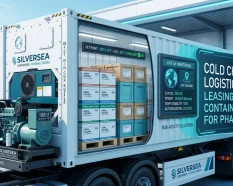
A reefer is a thermally insulated freight container fitted with an integrated refrigeration unit. WHO technical guidance describes reefers used for temperature-sensitive products and notes that the refrigeration unit needs an external electrical supply when the container is on a land-based site, ship or quay; road operations commonly use a generator.
- The active system changes the decision in three ways.
First, the unit can respond to thermal load and manage a configured setpoint within its verified operating capability. The exact range is unit-specific, so the setpoint printed in a brochure should never replace confirmation of model, condition and test results.
Second, an operating reefer depends on airflow. Integral reefers typically distribute conditioned air through the floor and return it above the load. If cargo covers the floor channels, exceeds the load line or blocks the return-air route, performance can deteriorate even when the refrigeration machine is working.
Third, the container becomes an operating asset rather than a passive box. Power availability, cable protection, alarms, drains, ventilation settings, maintenance response and monitoring all form part of the solution.
A reefer maintains conditions; it is not a substitute for process design
One of the most expensive buying mistakes is assuming that a reefer can be loaded with cargo at any temperature and will quickly correct it. In many transport operations, cargo should enter at or close to its required carriage temperature. Pull-down capability, acceptable loading practice and any need to pre-cool the cargo must be confirmed for the commodity, packaging, unit and operating context.
The same caution applies to compliance claims. A reefer does not make an operation GDP-compliant, food-safe or validated by itself. The wider system may require risk assessment, temperature mapping or qualification, calibrated monitoring, documented procedures, alarm response, cleaning and traceability.
Buyers with regulated or high-value cargo should define those requirements before equipment selection. For a sector-specific view, see our guide to reefers for pharmaceutical cold-chain operations.
Six checks before buying or leasing an Insulated Container or a Reefer
1. Define the thermal outcome
Start with the product or process requirement, not the container label.
Ask whether the operation needs:
• protection from short temperature spikes;
• a broad acceptable band over a known period;
• a precise setpoint;
• chilled, frozen or heated conditions;
• humidity or fresh-air management;
• continuous records, alarms or remote monitoring.
If the requirement is only “keep it cooler than a dry container”, the procurement brief is incomplete. Record the acceptable internal range, starting temperature, maximum exposure time and consequence of an excursion.
2. Model the real duty cycle
An insulated unit is affected by time and ambient exposure. A reefer is affected by thermal load and operating continuity.
In both cases, the real duty cycle matters:
• transport, static storage or both;
• expected ambient minimum and maximum;
• full sun or sheltered placement;
• number and duration of door openings;
• loading and unloading time;
• cargo mass and packaging;
• seasonal peaks;
• planned journey and handover points.
A passive solution that works for several hours in mild conditions may not work for several days in summer. An active solution can also fail if it is disconnected during a handover or repeatedly opened at a busy site.
3. Verify power before selecting a reefer
For stationary operation, confirm the supply at the exact placement point—not simply that the facility “has electricity”.
The electrical check should cover:
• voltage, phase and frequency required by the offered unit;
• socket and connector compatibility;
• available capacity and protective devices;
• cable route and protection from traffic or water;
• who connects and disconnects the unit;
• backup power and escalation procedure;
• metering if energy consumption matters commercially.
For transport, clarify where shore, terminal, vessel or genset power begins and ends. Responsibility during each handover should be explicit.
4. Check loading pattern and usable capacity
Nominal external size does not equal usable cargo space. Insulation reduces internal dimensions, and the refrigeration end of a reefer further affects internal length and capacity. Confirm dimensions from the offered unit rather than from a generic 20 ft or 40 ft chart.
For a reefer, ask for the permitted load height and airflow instructions. Keep the T-floor or air-delivery channels, return-air space and relevant vents clear. Pallet layout, packaging and restraints must support both cargo security and airflow.
For an insulated unit, review whether the floor, wall lining and door opening suit the planned handling equipment. If a NOR is proposed, confirm how the machinery housing changes access and capacity.
5. Inspect condition and test evidence
For an insulated container, examine:
• door seals and closing gear;
• panel damage, delamination or water ingress;
• floor condition;
• previous repairs and penetrations;
• odour, cleanliness and suitability for the intended goods;
• evidence supporting any claimed thermal performance.
For an operating reefer, add:
• pre-trip inspection or equivalent test status;
• refrigeration unit model and serial information;
• controller, sensors and alarm history where available;
• setpoint test and run test;
• cables, plugs, drains and door-gasket condition;
• maintenance responsibility and response time;
• refrigerant and service support relevant to the operating location.
A recent test reduces uncertainty, but it does not prove that the complete loaded operation will meet a cargo-specific requirement.
6. Compare total operating cost, not only the rate
An insulated container can avoid refrigeration energy and mechanical maintenance, but it is not cheaper if passive protection cannot meet the product requirement.
A reefer costs more to acquire or lease and operate, yet may be the lower-risk option where a temperature excursion would damage cargo or stop production.
Include:
• purchase price or lease rate;
• delivery, collection and lifting;
• electrical work and energy;
• genset or backup provision;
• inspection, servicing and repairs;
• monitoring and data costs;
• cleaning and return conditions;
• downtime or replacement support;
• residual value and expected reuse;
• financial exposure if the thermal requirement is missed.
When leasing makes more sense
Leasing is often useful when demand is temporary, seasonal or project-based; when the buyer needs flexibility between locations; or when equipment condition and service support matter more than ownership. It can also reduce the risk of buying a specialised asset before the operating model is proven.
Before signing, clarify minimum term, delivery and collection, maintenance split, damage liability, replacement response, energy costs, permitted cargo, cleaning standard and end-of-lease charges. Read more about maritime container leasing options from SILVERSEA Containers.
When buying makes more sense
Buying may suit repeated or long-duration use when the site has stable infrastructure, the organisation can maintain the asset and the expected utilisation supports ownership. The business case should include equipment life, refrigeration maintenance where applicable, relocation costs and residual value—not only the acquisition price.
If buying used equipment, insist on an inspection appropriate to the intended function. Cosmetic condition alone says little about insulation integrity or refrigeration performance. The SILVERSEA Containers shipping container cost guide explains why delivery, condition and operating requirements need to be included in the budget.
What EU and UK buyers should know about ATP
The ATP Agreement is relevant to certain international carriage of specified perishable foodstuffs using road and rail equipment. It classifies insulated and mechanically refrigerated equipment and sets technical requirements and testing arrangements within its scope.
It should not be cited as a universal certification for every maritime movement, domestic journey, stationary storage use or industrial material. Applicability depends on cargo, route, mode and jurisdiction. If ATP status matters, request the certificate and plate details for the specific equipment and verify that they cover the planned operation.
Other requirements may apply to food, pharmaceuticals, chemicals, workplace safety, electrical installation, transport and site use. The container choice should follow the compliance brief—not attempt to create it after procurement.
A practical decision rule
Choose an insulated container when the operation can tolerate temperature movement, the acceptable exposure window is defined, and passive protection has been shown to be sufficient.
Choose an operating reefer when the operation requires active temperature management and the site or route can support power, airflow, monitoring and maintenance.
If the requirement is regulated, high-value or not yet quantified, do not choose either option from a generic online specification. Define the process and request an equipment-specific proposal.
How SILVERSEA Containers can help narrow the choice?
SILVERSEA Containers supplies and leases new and used maritime containers across multiple markets. Availability, condition and configuration vary by location, so the most useful quotation starts with operational information rather than a container name.
When requesting a quote, include:
• cargo or intended use;
• packed dimensions and total weight;
• required temperature range and starting temperature;
• duration and location;
• transport or stationary use;
• door-opening pattern;
• site power;
• monitoring or documentation requirements;
• preferred lease term or purchase plan;
• delivery access and handling method.
Explore the range of maritime containers, or request a quote with those details so the team can confirm which equipment is available and appropriate for the project.
Share the packed dimensions, weight, handling method and location with SILVERSEA Containers.
Frequently asked questions
An insulated container slows heat transfer but does not actively correct temperature drift. An operating reefer uses a refrigeration system to manage a configured setpoint and requires power while operating.
It can slow warming if the cargo starts at the required temperature, but performance depends on insulation condition, ambient exposure, duration and door openings. It should not be assumed to hold a precise temperature without evidence for the actual use case.
No. A NOR is a reefer used without active refrigeration. It may still contain inactive machinery and offer different internal capacity, condition and transport acceptance from a purpose-built insulated container.
Yes, while its refrigeration unit is operating. The exact electrical specification depends on the unit, and transport may require a genset or other power arrangement between powered locations.
For many transport operations, cargo should be loaded at or near its required carriage temperature. The exact preparation and loading procedure depends on the commodity, packaging and reefer specification; do not assume the unit can rapidly cool warm cargo.
Lease for temporary, seasonal or uncertain demand when flexibility and support are priorities. Buy when utilisation is long-term and predictable and the organisation can support maintenance, power and relocation. Compare total operating cost in both cases.